Sunday, 20 January 2013

Bumper issue. Majorelle, Hoar Frost,Tulips and Barrows - push or pull?

Having been away for so long  I thought I better get out a  bumper issue to make up for lost posts.  Here it is.

 I’ve bin on me ‘olidays. Can you guess where? Here’s a clue which you will have to be of a certain age and of a certain musical bent for it to be any use to you.

 Looking at the world through the sunset in your eyes
Travelling the train through clear xxxxxxxx  skies
Ducks and pigs and chickens call
Animal carpet wall to wall
American ladies five-foot tall in blue.

Sweeping cobwebs from the edges of my mind
Had to get away to see what we could find
Hope the days that lie ahead
Bring us back to where they've led
Listen not to what's been said to you
Goddit?

Well, it was Marrakesh, (Marrakesh in the song Marrakesh Express by Crosby Stills and Nash 1969 but Marrakech in the country today.), the third largest city in Morocco and Wikipedia has just told me it attracts two million tourists a year.

One of the highlights of the holiday was the Majorelle garden in the north of the city. It was the most organised, clean, and unbroken down places we came across.

It was garden created by artist Jacques Majorelle on a plot of 1.6 hectares which he bought in 1923. He called the property Bou Saf Saf and his house  and workshop Villa Bou Saf Saf . By buying adjacent land he gradually expanded the garden to  4 hectares. He opened it to the public in 1947 to help offset the considerable costs of maintenance. Majorelle went through a divorce was remarried and suffered a serious car accident and then another and had to a leg amputated. Due to financial difficulties he had to give up his involvement  in the workshop, house and garden in 1961 and had to return to France where he died in 1962.

Yves Saint  Laurent and his partner Pierre Berge visited the garden in 1966 on a visit to Marrakech  and were taken by the  colours and shapes  of the  plants and garden  if not by the condition it was then in. On learning that it was to be sold and a hotel built on the land they decided to buy the property and did so in 1980. He renamed the house Villa Oasis and lived there working on the restoration of the garden. Irrigation was installed to provide for the individual requirements of the different species of plant. The number of species was increased from 135 in 1999 to some 300 today. Twenty gardeners now take care of the plants, garden ornaments and water  features and the    seventy five people in total are employed to run the property.

Yves Saint Laurent died in Paris in 2008 but his ashes are scattered in the garden in Marrakech.

If you get chance to  visit the garden (Get in there  either early or late in the day  to avoid the visitors  that arrive  in considerable numbers  on  coaches.)  and be sure to  pay the extra  for  a ticket into the Berber museum which was opened in December 2011  in what was the artists’ workshop. It is beautifully designed and the  Berber artefacts , clothing , jewellery are  wonderfully displayed and   comprehensively explained. The garden and museum are now run by the Fondation Majorelle and profits are used to support other projects in Morocco. 


Here are some holiday snaps.
Jacques Majorelle’s and later Yves Saint Laurent’s house.

If you like the blue colour check out Auro paint suppliers. It is one of their concentrated colours which are intended to be diluted with whites and pastels to  paler colours  but used neat gives this intense  colour. 

The garden is neatly raked and the soil dished around the plants to aid watering. Alongside all the exotic succulents it surprised me to see Acanthus mollis. It is in the foreground here. It is a robust,  semi- evergreen, shade tolerant, herbaceous  perennial  that grows well in the UK and  it turns out it has more right to be in the garden than all the other plants because it is native to North West Africa.

Cacti and succulents make up a large part of the planting and give drama to the garden through their shape and size.


As sometimes happens when you are on holiday and  feeling relaxed away from the    responsibilities  and constraints of everyday life, I had a holiday romance. There was no physical intimacy unfortunately because the sudden love of my life was kept ten yards inside the railings.  No, I had not fallen for a hippo at the local zoo. The object of my head over heels love was the gorgeous thing above.  The Bismarck Palm – such  an unfortunate name for one so lovely.

She  is a plant  from the highlands of central Madagascar. She is adorable. Coming from uplands with cooler winters she is able to tolerate  lower temperatures than might be expected, down as far  as freezing in fact  though not much below that. So if you have a  sheltered spot give her a try though be aware that if she likes you and does manage to grow happily she can make twenty five   metres high and each leaf can make three metres across - oh how heavenly that would be.    


Oh, how could you resist such a plant!
Bismarckia nobilis - pah! Let’s rename it with something more  elegant . How about Palmia gloriosa or Exaltat formosus, even  Madagascaria  gloriosa?   No? Okay.  I wonder what the Madagascans  call it in Malagasy, surely something beautiful?


The  structures  are simple  and the shapes and colours very strong giving many of the views  the quality of a child’s painting.


It’s drama all the way.


The garden has the feel of a botanic garden in places with plants arranged as isolated specimens rather than as a part of a co-ordinated  ornamental design.     


Interest ranges from squat barrel cacti at ground level to towering palms heading to the skies.


 Bamboos flank the far paths. This is not the best of pictures because there is no reference of scale  but the new green shoot in the foreground is about two and a half metres tall and as thick as your forearm. The Swiss Cheese plants in the background give some idea of how big the bamboo shoots are.
...................................

What’s the marra with ya barra?
Any physicists  out  there? No need for  a particle or astro kind just a good old fashioned practical type who understands gradients, friction and can cope with factoring in a few variables.

My  challenge , which  is  a problem  that  has me in a quandary  whenever I work in  a  particular garden  of which a good part is on a  slope   and  the  compost bin is right at the top of the  garden up a steep and sometimes muddy slope, is this. Which is the most efficient way to get a barrow to the top of the hill? Is it pushing the barrow up before you or pulling it up behind you? My basic  understanding of physics tells me that the same amount of energy must be used  whichever way  you  do it, everything else being equal,   because   in both cases  you  are   moving the load  a  certain distance  and raising it a  certain  height in roughly the same time.   However it is the variables that are the spanners in the works and while they   do not affect the weight or distance moved they do affect the comfort, safety and endurance of the barrow pusher/puller.
Let’s consider the two different techniques.  First pushing the barrow. Here I always feel that I am pushing the barrow more into the ground than  along the  line of travel, particularly if the slope  is steep and the load heavy because you have to lift  the handles to give you weight  to help give  your feet some grip on the ground. If you don’t lift the handles  then you have to lean well forward which means the  weight is on your toes  and you have less contact ( and therefore  less grip)  with the ground and the danger then is that your feet will  slip and  shoot out behind you  and any slips at this stage means there is a chance the barrow will run back onto you. Of course all this depends on how slippery the surface is and also  what sort of  footwear you have  on; a good pair of well cleated boots will give you more security and confidence to shove than a pair of smooth soles more suited to a soft shoe shuffle. So as as you see Mr Physicist, it is not all as straightforward as you might think.

The other way is to pull the barrow up the hill but that brings its own problems. Here again the  task is made more difficult on slippery ground because you have to lean forward to  be able to pull  properly and then there is the risk of  your feet slipping   under the barrow and  skinning the back of  your heels This can also happen if the barrow is of poor design  and the handles  are too short. One advantage with pulling is that it is easier to keep the flat of your foot on the ground which gives you more grip. Something else that can catch you out is if the grips on the handles are loose and suddenly slip off when you are pulling your hardest and you go flying and so does the barrow. 

I can feel your yawns from here and hear you wondering why on earth is he telling us all this; who cares? I guess you are right, who cares? Perhaps rather than a serious consideration of the physics of the Barrow Dilemma this could well be a more worrying symptom of what happens when you work too long on your own. I love gardening, there is no doubt about that, but much of it is really quite boring  so when you are working  away on your own, particularly if the task is tedious and arduous, your mind tends to  latch on to distractions. These minor entertainments often set off a train of thought that runs on a course of its own and is sometimes unstoppable at least until the buffers of a more interesting job are hit. That is how the barrow thoughts started off. The job of lugging barrow loads of garden waste to the top of a slippery hill  made more demanding by fatigue and aching  joints desperately needed a distraction. Working out the advantages and disadvantages of each   style made it into an experiment which kept me so preoccupied  with the physics that, hey, before I knew  it the sun was setting and it was time to knock off.
P.S. Whichever way you choose, push or pull, make sure your tyres are blown up hard.

................................ 

Hoar Frost.
As ever nature provides tons of free entertainment in the garden. A recent hoar frost brought a welcome bit of sparkle to a cold and overcast day. Here are some pictures of some of the intimate treats laid on by nature. (Hoar frost has nothing do with getting the cold shoulder down at your local brothel).


Viburnum flowers - brave souls.


Spider’s web and four very handsome fingers..

Cherry Laurel leaves trimmed with icy spikes.


There are advantages to not cutting your plants back too soon.  This is an Agapanthus head strung with tinsel-like frost and surprisingly green for December.


It’s curious how the frost only develops on one side of the branches in certain parts of the garden.
Caused by a very gentle breeze perhaps?


A very ordinary elderberry seedling becomes rather special. What is it doing still bearing  its leaves in December?


Good old Jack F.


 .......................................

Tulip Bulbs.
Can I draw your attention to this quarter’s issue of Hortus  and more particularly the cover? For me it illustrates the  great pleasure to be had from noticing the ordinary which when noticed transcends the ordinary which then becomes the very special.  It is a simple but beautifully executed ink and water colour picture by Simon Dorell   It shows  twelve bulbs  set out  in a regular pattern and the thrill of thrills for me is  that  they are my favourite bulbs and I am excited that someone else has been moved by their shape and texture and in this case moved  enough and with the skill enough to paint them. I am talking about the bulbs themselves here not the flower. The bulb is Tulipa batalinii ‘Bronze Charm’. The flower of this tulip is small and utterly charming but the pleasure starts way before the flower shows itself. It starts at planting time.Take a bulb in your hand  and you will see that it is much smaller than your usual bedding tulip; each bulb is loosely wrapped in  a papery, not fragile but usually split, skin of the warmest, softest  brown with a matt almost downy surface. At the base of each bulb where last year’s roots have withered away is a knobbly pig’s nose. At the other, top, end is a small, tight tuft of soft bristles. The whole is a masterpiece of tactile, textural and visual delight that it almost seems a sacrilege to bury it in the ground.

The lightly textured and matt finish of the paper that Hortus is printed on makes the perfect foundation for this picture. Do your best to get hold of a copy. (The Hortus website image does not do the picture any sort of justice)

P.S. Seen with Magoo vision the picture  can also look like twelve  snails on a ceremonial march- past but don’t let that  put you off.

 Not Tulipa ‘Bronze Charm’ but the very similar ‘Bright Gem’. It is a poor picture but none the less captures the heart melting charm of these oft over-looked but very easily grown small tulips.

 ..............................

 Ivor Field speaks to the nation.
As gardeners we are always encouraged to get as much organic matter into the soil as possible to improve its structure and water holding capacity.  I was wondering how farmers  keep their soil in good condition and was also wondering about potato crops  some of which I know of, not far from here, are still in the ground and  bearing in mind the amount of rain we have  suffered  how are farmers coping, so I asked Ivor for his views.  

‘’Hi Paul, Yes very wet still but the January outlook at least shows signs of drier weather – Locally only about 30% of winter wheat planted and lots of crops looking v.thin (slug damage and rotting of seed due to waterlogging). The potato situation is pretty dire- most of those crops will be lost now. Biggest problem is also those that have been lifted and in store – many will rot in storage due to poor conditions at lifting last autumn. You will notice many more blemishes on the tubers this year.  Let’s hope for a better spring but when you have nearly 40 inches of rain from mid-April onwards, the Organic Matter levels have limited impact – You are right, the more OM the better the soil can cope but once the land saturated and the water table as high as it is then the only thing is patience! OM are increasing with many more combinable crops returning the straw to the land rather than baling – particularly with the break crops of Rape and Beans – the cereal straw in our part of the world still of great feed value/bedding for the livestock farms, particularly further west(Wales) where arable crops are sparse. The burning ban has helped Organic Matter status but made grass weed control much more difficult. You will notice a lot more fields with black heaps of sludge in them over the last 3 years or so – this is human sewage sludge from the Sewage Treatment Plants from nearby and is being used to raise fertility and improve Organic Matter/soil structure. Only limited amounts can be applied every few years to avoid a build-up of heavy metals (cadmium etc. which are harmful to health) and helps solve the Water Companies problem of what to do with all the waste!! Controlling Tomato and Caraway plants that appear in the crops in late spring following the spreading of the human waste is also interesting – such are the challenges facing an agronomist, farmers and a nation of curry lovers! Happy New Year, Ivor.’’

.................................. 


The Girls head South.


I have received a letter from my old pals Grace an’ Perry. (Yes, she is the genuine champagne Perry but Grace is just Grace.). They have moved from their home in the Lake District and are now living right deep in the South West and learning Japanese. What on earth are you girls doing down there?  Is there another major garden project underway? Let’s hope so. Or are you chasing men?  What’s with the Japanese lingo, I can’t believe there’s a Japanese diaspora near St Ives. I don’t want to hear you are developing a Japanese garden; leave it to the Japanese. Is it that painterly light that lured you so far down south? It would surely suit your style. Anyway, that photo of a plant you sent me, ( Poor picture by the way.)I can’t believe you don’t know what it is. Is it growing at your new property? Was the picture taken recently because it often flowers through the winter in a sheltered spot though a cold snap will slow it up a bit? It grows in a tangled sort of way up to about a metre high and is evergreen.  It is quite a  gem. Its soft lemon yellow pea flowers complement perfectly the grey tinged leaves. The  variety  ‘Citrina’  is a pale flowered selection of the less exciting  bright yellow  flowered  Coronilla valentina subsp. glauca which is a blue grey leaved subspecies of the green leaved and more  brazen yellow flowered Coronilla valentina, complicated eh? But not to worry you have the choicest variety of them all there. Take a sniff. You will find the flowers carry a light, fresh scent. Cut a small posy for the house if your plant is large enough to stand the loss, and enjoy its scent indoors

Be sure to let me know  what you are up to – we have readers who want to know!


......................... 

Autumn Colour.
Here is a picture of a slow growing shrub in my garden. It has been there four years and has not yet been pruned. It went in at  about two feet high  and though I don’t know exactly how big it is now  you can see by the heads of the Echinacea  and Eryngium in the foreground it is still not very big,  a yard  and a half max. Snag is I can’t remember what it is. I think it is a Rhamnus but can’t be sure. It gives  you a fuzzy ,soft effect during the summer with its narrow foliage and then in the autumn explodes into this starburst of fierce yellow. Great value and minimal maintenance – BUT WHAT  IS IT?   M’AIDEZ!

Half an hour later  ………. It’s funny how things come to mind when you stop thinking about them. Rhamnus frangula ‘Asplenifolia’
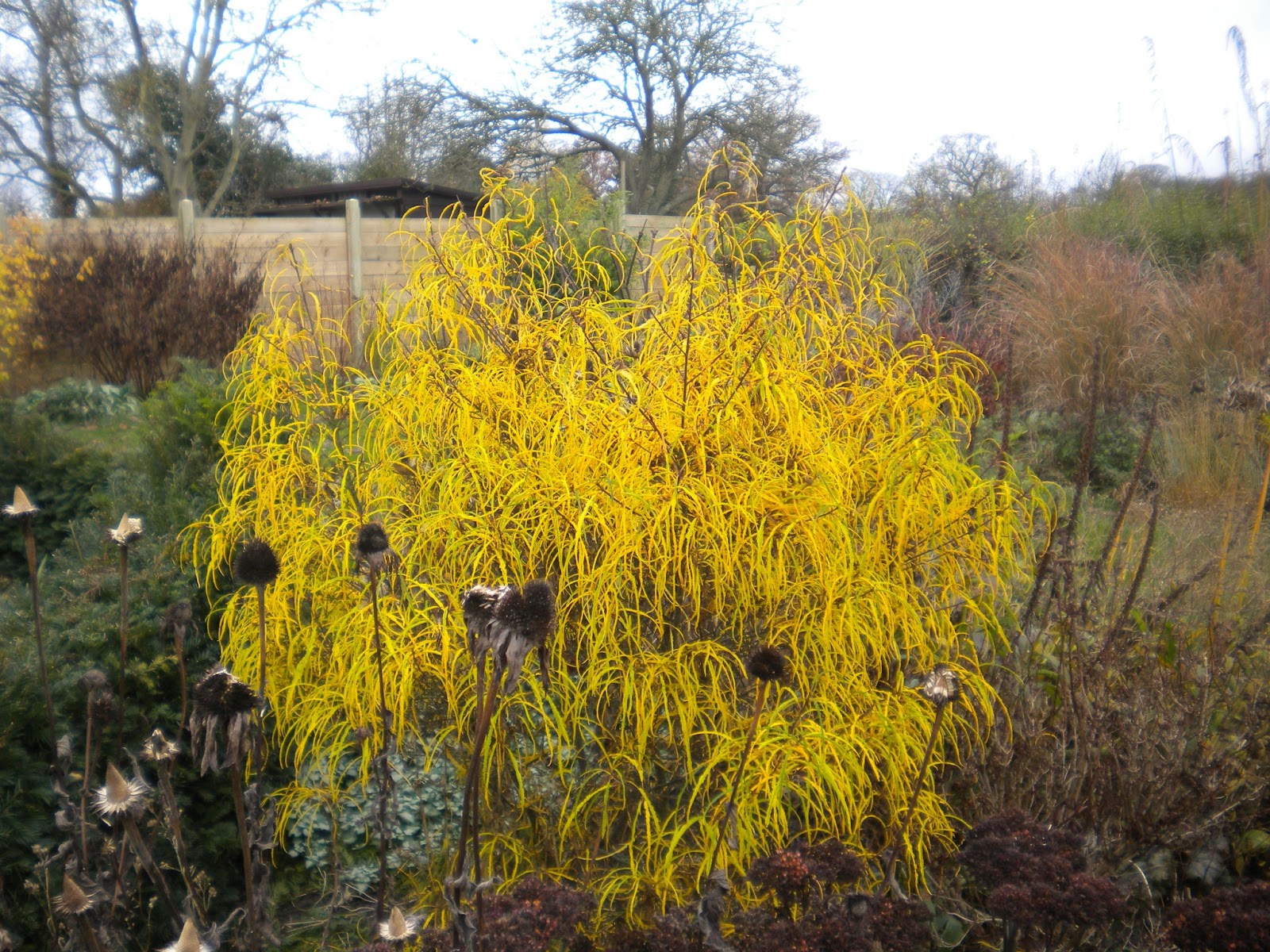
A compact and slow growing shrub that holds onto its autumn colour for a long time.
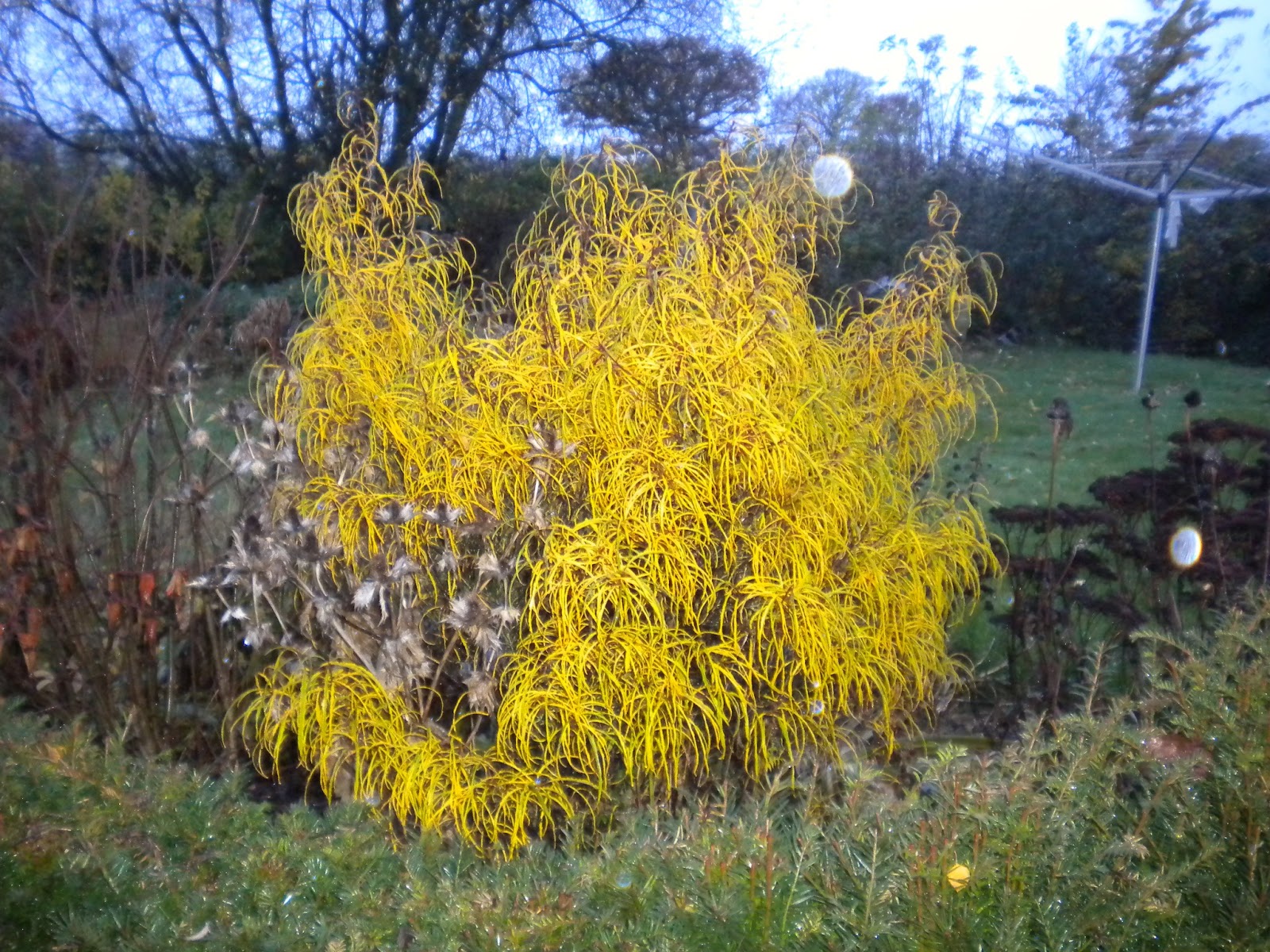

Very narrow leaves hang like firework bursts frozen in time.

...................................

Know your onions.
Take a look at the label from a pack of Senshu WINTER onion sets for planting in August to September to grow through the WINTER. Read the line just above the diagrams.


There are a surprising number of anomalies on plant labels. Send me any you come across via the comments section.


Too twee or not too twee?

Being of a cynical nature I don't usually do twee but I was working in a garden recently and I could not help but feel for this poor little mite. I was tempted to take her home and warm her chilled ceramic heart. 


.................................

Pruning Surprises.
Things you know you know can still take you by surprise.

I was pruning a Berberis and an Elaeagnus recently and I know they have lighter undersides to the leaves but was taken aback by quite how white they are on the undersides of the leaves. Having silvery upper surfaces I can understand because it can offer some protection against  a scorching sun but a silvery underneath is a bit of a mystery. Any ideas anyone?                                                                                                                                                                         

Here are a couple of pictures showing the  brilliant undersides.

Top……

                                                           …….and bottom. Dazzling!


An evergreen Berberis ,( sorry I don’t which one but it is not a rare one,) with an upturned pruned branch laid against it. In real life it was more startling than this picture makes it.

...........................

 Seen and Heard, Odds and Sods.

What gets worshipped where? -  Synagogue, Welligogue, Guzgogue.

‘…….people who bought this also bought War and Peace by Tolstoy, T.S.Eliot, Collected Poems, Crime and Punishment by  Dostoevsky and a subscription to Playboy magazine.’     What?
‘…… there were a lot of  children off school  today; they said it was something to do with an insect day….. ‘

Horses for courses.    Main Course - Burger with chips. 
‘Mixed Race’………..  Sack, three  legged,  and egg and spoon  100 yards medley.


A.BC -- WXY.Z ( That’s Zee to make it rhyme.)
It’s curious the things that come to mind when you’re lying awake up at 3 in the morning. In my mind I was picturing the (I was completely sober and I have never done drugs in my life) alphabet  written out in capitols, sorry, capitals, and as is the way in dreams I could not see  the whole of each letter just the tops.  I noticed that after A they all had flat or roundish  tops, BCDEFG,  until you came  to H which had two pointy tops  and then there were a series of letters with pointy  tops I J K L M N then back to  flat tops OPQRST then pointy again UVWXY  and a flat  top Z to finish.  So, a single pointy to start and a single flatty to finish. Curious how the shapes of the tops   are all grouped together rather than mixed up. I did wonder if there was not some code to the meaning of  life  hidden in the grouping  but that is the sort of thing you think at 3.15 am when you are only half awake.  Still, it is an odd arrangement.  Alien intervention?  Da Vinci code conspiracy? Quick, under the duvet, here come the men in white coats.
9V*DC
 BACK IN PLAQUE  
Is it true that someone has invented a cheap device that you strap to your wrist and it vibrates your hand to simulate the action of an electric toothbrush so that you can use your favourite  manual toothbrush  but get the advantages of an electric toothbrush? 

If it is true it won’t be long before you can get a  toothbrush app which uses the vibrating   facility  on your  phone  and a clip-on  toothbrush head  to give you the perfect travel toothbrush- you wait and see!                                                                                                                                                                              


Sunday, 28 October 2012

Incey wincey, Codlings and Cream...

Before you settle down to read this and because we haven’t done it for a while, I would like you to join me in the chorus of that lovely tune that is our eponym. Clear your throat and join me at full volume in a rousing chorus. I’ll count you in… 

1…. 2……3 …. 4 go

‘DaDa Daa Da Daa Da Da Daa Bom Bom
DaDa Daa Da Daa Da Da Daa Bom Bom
DaDa Daa Da Daa Da Da Daa
And sweet Marie who waits for me there. ‘

That’s it. Feel better now? Good. On with the show.

Can you pat your head and rub circles on your tummy at the same time? If you are shouting ‘Of course I can!’ the odds are you are a multi-tasking female who can split her thinking several ways at once. (Don’t look so smug). Now, keep patting and rubbing while standing on one leg the foot of which is balancing on a tightly inflated football. Still standing? If you are you are still only half way to being as good as the spider I have been watching. 

It’s that time of year when those large round bodied spiders which I have always called orb spiders seem to be more abundant and the mists and dew of autumn bejewel the webs to make them more obvious. The orb in the name comes from the shape of the web rather than the spider. There are several genera that do it. They make strong webs which you will easily feel tugging at your eyelashes and hair if you unwittingly walk through one. I was watching one of these beautifully speckled spiders building its web which it had strung between two, head high, rows of wood stacked some five feet apart. These two rows of split logs formed a corridor twenty feet or more long and glancing along this space I could see five or six of these webs strung at regular spaces like sinister lines of washing stretched high from balcony to balcony across a narrow street. Beware inattentive fly.

Earlier that day this spider had cast a thread to the wind which had carried across the space between the log piles and stuck to the other pile. Having secured both ends and attached another couple of lines to each side and put in place some radial threads the spider started to build its spiralling web, working from the outside to the centre. I only arrived in time to see it lay down the last few threads near the centre and it is here I observed what looked like an amazing display of dextrousness and balance. With one of its legs it drew the thread from the spinners in its rear and moved it across from one radial to the next and laid it on the radial, then with another leg it seemed to push the thread away from itself thus pushing it tightly against the radial as if to make doubly sure it was stuck on. This was not done in any sort of hesitant or careful way, the spider just quickly, rhythmically and unassumingly worked its way round and round laying down the threads while having all of its eight legs under perfect control with each being put down, without miss, on a thread when not involved in the task in hand. How does it know where the threads are to put its feet down so assuredly? I don’t know, but I do know it has had eons of evolution to perfect the knack and its six or eight eyes (One to watch each leg?) must surely help.

The web thread itself is a great resource and not to be wasted so when the web becomes ragged or worn out the spider will eat it before building another web. Have you ever wondered whether the spider bothers with those tiny gnats and aphids that start to build up on a web? Well some of the larger spiders won’t bother with them until they eat up the old web and these tiny catches get gobbled up at the same time. The spider severs the silk thread not by cutting but by applying digestive juices to it. 

Codlings and Cream


Do your apples look like this at the end of the season? There are two problems here, the most obvious of which is the damage to the core. This is cause by the codling moth Cydia pomonella


The adult female moth lays eggs on fruit and leaves in June /July. Caterpillars hatch two weeks later and burrow into the developing fruit often boring inconspicuously in at the end where the flower was - the opposite end to the stalk. They then feed for a month or so then eat their way out and pupate on the plant, under leaves and in cracks and crevices. Note this and note it well – the adults fly onto the apple tree and the larvae pupate on the tree. There is no crawling up and down the trunk to be caught by sticky grease bands. Codling moths are not controlled, as is often thought, by grease bands around the trunk of the tree. Grease bands are to stop the wingless female moths of the Winter Moth climbing up the trunk to lay eggs.

Treating codling moth is not easy. To use chemical sprays you have to time it so that you hit the caterpillar between hatching and entering the fruit which is tricky and anyway I don’t think there is a chemical recommended for the amateur for use on fruit trees but practically it is not realistic to spray a large tree. Pheromone traps which use a sex hormone to attract and trap the males were used to alert fruit growers to the presence of the moths so that they could apply an insecticide at the right time. It is doubtful if they are effective in reducing populations in a significant way because moths are all too ready to fly in from surrounding trees.

So there is your Codling – a codling is an unripe or cooking apple – along with its moth.

But what about your cream?

Well here it is in all its piled on glory. 


‘One giant scone for mankind’ said Neil Armstrong as he stepped towards this mountainous cream tea at Hobson’s Patisserie, Henley Street in Stratford on Avon. You can just see where he touched down, his moon boot pattern imprinted on the dusty surface of the scone. Eating this is akin to assaulting the north face of the Eiger, with both the tip of your nose and the end of your chin at risk of frost bite as you figure out the best way to approach it.

Now if there are any field botanists going ‘Wah! Wah! Wah! What about the real codlings and cream Williams?’ I am going to have to disappoint you because I could not find one in flower to photograph. Codlings or codlins and cream is the common name of the Hairy or Great Willowherb Epilobium hirsutum (hirsutum = hairy) which is the more leafy brother of the great Rosebay Willowherb Epilobium angustifolium (angustifolium = narrow leafed.) that brightens up our hedgerows and railway lines in late summer with its tall spikes of intensely coloured pink purple flowers. The Hairy Willowherb prefers much damper ground. I struggle to see the connection between the flowers, which I am guessing must be where the connection is made, and codlings and cream which which are not at all pink though the flower does have a cream coloured centre. If you know the connection then let me know.

Caterpillar Tracks


This cabbage white caterpillar on Cleome spinosa struck me as bit of an anomaly at first because I would have expected it to be feeding only on members of the family Brassicaceae, the cabbage family and no part of the Cleome plant says cabbage to me. A quick search told me that, after recent DNA analysis, Cleome had been placed in a new family because it was much more closely related to the Brassicas than had been thought; they could have saved a lot of money and research time if they had just asked the caterpillar.


A more obvious victim is Crambe cordifolia above. This is definitely a member of the brassica family and here has been stripped to the veins by the caterpillar. Anyone who has grown Crambe will know that its huge leaves are often damaged by another pest of brassicas, the flea beetle. This tiny beetle punctures the leaves with a myriad of tiny holes, spoiling the look of them completely. You can sometimes hear them pinging on the leaves as they jump about when you disturb them. Grow this Crambe them towards the back of the border where the huge sprays of white flowers can be enjoyed without the distraction of the mangy leaves. Treat roses and hollyhocks the same.

Scary Monsters 2


I was asked to judge the fruit and veg at the Stretton on Fosse Horticultural Show in September and a great show it was too especially as it was the first for as long as most people could remember. As good as the flowers and veg were, for me it was the children’s entries for the ‘Scariest Animal made from Veg.’ class that stole the show. 


Magical Mushrooms


Not the sharpest of pictures but what a colour. It was growing in sandy soil amongst wood chip mulch at the base of a yew hedge on the edge of Cheltenham. I used the wonderful service that is ispot to find out that it is a species of Stropharia.

Let’s just get this out of the way. - Why did the girl go out with the blue mushroom ? Because he was a fungi to be with. Gerrit?

Berry Good


Okay , what’s this then?

I spotted it in the architectural salvage paradise that is the Three Pigeons outpost of Lassco near Oxford. There was a case of old garden tools displayed by Garden and Wood and amongst them was this little gem. It is photographed through glass so it is a bit hazy but I am sure you can make out the rows of prongs and wires across its base. It’s a berry harvester , French of course, and if I never harvested a berry with it I would be content to enjoy its boxy yet elegant construction, its attractive angles and its ‘I was thoughtfully made for a specific purpose’ character. I imagine it would be used to harvest berries such as red, white and blackcurrants and maybe elderberries by scooping through the strigs and gently tugging and tipping back to land the loosened berries in the collecting box at the back with creepy crawlies and juice from burst berries falling through the wire screen base.

Or is it an S. and M. backscratcher. No, not Sparks and Menser.

What Was He Doing?


And on the eighth day, with nothing to do, God made the ugliest thing he could think of, the Cockchafer grub. With His schoolboy sense of humour He could not resist giving it a name perfectly suited to double entendres. He also gave it a scientific name designed for us to easily remember, Melolontha melolontha. This soil-dwelling creature spends its time chewing a way at roots underground perhaps for several years before emerging around May, (hence its other common name May Bug), as a large brown and black beetle-like creature over an inch long which seems to have little navigational sense if the number that have crashed into me when I have been fishing by the riverside is anything to go by. There are two in the picture , both freshly dug from about 18 inches down, but I am sure the dark one is dead. It did not move at all during the photoshoot, not even for me to get its best side. The other one wiggled and squirmed the whole time. The adults chew leaves and can on warm nights swarm into trees in great numbers - that sounds like my ultimate nightmare. There is a superb picture of one in flight and some gloriously detailed text in Peter Marren and Richard Mabey’s Bugs Brittanica published by Chatto and Windus. 


I'm A Bit Rusty


I have received a request for help from Lee Cleaves.

He has sent me the picture below from his allotment and wonders what he can do about whatever is affecting his leeks.

What you have here Lee is a rust disease on your leeks called, rather surprisingly, leek rust, Puccinia alli. I have the same problem on my leeks this year. I think mine has cross infected from my Chives which had it bad last year.

Rusts are mighty interesting fungi with several types of spores produced for different functions and we might have a look at them in greater depth in another issue.

But back to Lee’s leeks. The leek rust is typical of rust fungi in that it produces pustules of orangeish – rusty – coloured spores which get blown or splashed about thus spreading the disease. These narrow, slit like, pustules are produced on the leaves and don’t usually penetrate the centre of the leek though a bad infection can reduce the vigour of the plant. The disease’s spread usually slows down with the onset of autumn.The spread of the disease is encouraged by damp and wet weather.

The second picture with black dots shows what look like a different type of spore, a teliospore, which my book tells me you don’t get on leeks so where does that leave us?

Can you do anything to prevent the problem? Make sure you clean away any leek debris from the site to prevent it infecting next years crop. I generally discard the unwanted leaves and leave them lying on the garden which is not good practice. In my case it would probably pay me to get rid of or reduce my chives to avoid any spread from them. Practice as long a rotation as you can to reduce the number of spores in the ground. Four years or more if you can. Growing resistant varieties is always a useful way of coping with any disease. The varieties Oarsman F1, Upton and Swiss Giant all show resistance to rust. Plant you leeks with plenty of space around them and in an open and airy place.


Hell for Leather on the Helter Skelter


Two pictures here, one I took on a visit to the Olympic park before completion and another taken on a trip to Southend and its amusement park. Which is which (the large banner in one picture might give you a clue) and did one of them influence the design of the other? 


Sunday, 16 September 2012

Bugs, Bees and Scary Monsters

‘Raise the song of harvest home.

All is safely gathered in

Ere the winter storms begin.’


I am writing this during the glorious sunny weather of early September. Here in South Warwickshire it seems as if the farmers have been gripped by the Olympic spirit and were all ready with their toes up to the line just waiting for the starting pistol of this hot spell to launch them into a frantic frenzy of harvesting. Everyone is flat out. I don’t think you could get hold of a spare harvester, tractor or trailer this week for love nor money.  

Forget any plans for making a quick journey through back lanes as first the dismantled harvester, cutting unit going on ahead on a trailer, pulls out followed by the ungainly looking threshing and winnowing unit, and then the grain trailers continually shuttling back and forth take up the road and leave you in first gear doing your best to be patient.

Great clouds of dust churn from the combine harvesters as they spout the grain into trailers running alongside, trailers with their fat tyres spreading as the weight of the spilling grain increases, eager to get away, be emptied and then back for more . Tractors heave their loads out of the field gates and down the road. Grain finds the gaps in the trailers tailgate and slips out bouncing high back down the road and gathering on the corners. The swathes cut neatly through the standing corn, the sharp dark shadows of the cut edges stark against the almost white stubble and the regular stacks of baled straw all have a satisfying geometry. Floodlighting headlamps keep the machinery going through the night. My three in the morning trip along the landing allows me a glance at this relentless activity ; lit up like a distant oil platform with lesser lights ferrying back and forth , the rhythmic riverboat thrumming of the turning mechanism and surely some very weary drivers racing against the coming rain but with the thought of heavy wage packets helping to keep fatigue at bay.

Bugged.


As part of the Daily Mail and Scotts sponsored Gardening Question Time Roadshow panel - Barry Gayton and me -I have been out and about at garden shows around the country answering people’s queries and sometimes getting stumped by the odd question. One of the good sides of not knowing the answer is that it makes you go and find out and the finding out sometimes leads you down an unexpected but very rewarding path. One lady, Sue, showed me a picture of a bug below. To give you an idea of scale the bug is sat on a plant label (It is low res. so I hope you can see it okay.). She wondered if it was one of the Harlequin ladybirds that are becoming established in this country. I knew what it wasn’t; a Harlequin ladybird, but I did not know what it was. My first thought was that it was the insect world’s own version of a Star Wars Storm Trooper. Take a look. I checked all my insect books without success so I posted the image on the ispot website and within minutes I had the most comprehensive identification and a reference to the Pied Shieldbug lifecycle. 

The bug was the final instar ( larval stage ) of the Pied Shieldbug and if you take a look at the reference above you will see from the completely different looking adult why , even though I had Pied Shieldbugs in my reference book, I could not track it down. Ispot.org.uk is part of the Open University and anything you post is seen by any number of specialists who are keen to identify what you have sent in. I am sure they get excited by what might look to be something rare but they are just as happy to identify the more common natural history subjects. Sign up and give it a go and check out the British Bugs site, it is remarkably good with superb photography. Natural history is an integral part of gardening and you cannot ignore it particularly as we are all being encouraged to do our bit for wildlife so go take a look at this site and you will then want to buy a x10 hand lens and the maybe a modest microscope and then a macro lens and then a camera that will fit your microscope – it can be addictive. I am at the modest microscope stage but maybe a new lens will be on my Christmas list.

I will be out and about doing more of the Gardening Question Time shows next year which I will post here on my blog in good time should you want to come along. I have just opened a twitter account but I have to confess I am not quite sure what to do with it yet but I am sure to have the hang of it soon so if you also tweet then lookout for my news – if you want to of course. I do feel it is a bit presumptive that anyone should care two hoots about what I get up to.

Pied Shieldbug

Lazy B's.


If you grow runner beans then you will know that bees have found a sneaky way of getting at the nectar without having the faff of having to bury themselves in the flower and get covered in pollen - which is what you really want them to do to help set the flowers. They simply make a hole further up the flower towards the stalk and put their tongues through the hole and take the nectar.

I have a Fuchsia magellanica growing too near my garden path and at this time of the year you have to brush along it to get past and it is alive with bees. I stopped to watch them coming and going, bumbles and honey bees both. I expected to see them dangling awkwardly off the end of the anthers trying to scramble their way up into the centre of the flower for the nectar. Not so. They had either learned from their bean experience or found out anew that they could short cut the system and go straight in at the top of the flower. In the pictures you can see the holes they make. Judging by the look of the swelling seed case it doesn’t seem to affect pollination so they may well be self fertile.

Fuchsia magellanica flowers.

Sneaky bees take a short cut to the nectar  by making a hole  at the top of the fuchsia flower


Scary monsters 

Those big ‘Don’t mess with me’ eyes are all a sham. This 3 inch long Elephant Hawk moth caterpillar rears its ‘head’ in the hope of scaring me off.


Those big ‘Don’t mess with me’ eyes are all a sham.
Rain gives the normally matt finished caterpillar a gloss.

As it settles down and makes its way off, the tiny, far less fearsome, head can be seen stretching out at front something like an elephant’s trunk and hence its name. It will be heading off to find willowherb, bedstraw or your Fuchsias to feed on. The adult is a large, handsome, bronze/ green and pink moth.

As it settles down and makes  its way off, the tiny, far less fearsome head  can be seen stretching out at front.

Strange goings on.


We veer off the garden path here with a local story of some considerable mystery.

Our science correspondent and avid conspiracy theorist Lidll Groenmenn has reported that a small village in central England is proposing to emulate the recent successes of the Chinese space programme and put a man and his dog, Spot, into space. Rather than return to earth Chinese style slung beneath a huge parachute they are aiming for a reusable craft that will use wings similar to the very successful American Space Shuttle. The launch team stress they have no plans at this stage to visit the International Space Station.

Lidll says there is considerable secrecy about the scheme and the intended landing site has not been disclosed though it will require a runway which limits it to one of the local airfields or possibly Birmingham International. Rumours that a long straight section of the nearby Roman road may be closed to accommodate the landing have not been commented on by the highway authority.

Liddl was able to breach the security fence to take the picture below of the rocket being readied for launch. The picture shows the pattern of the heat resistance tiles and some heat scorch marks from the forward thrusters. It also shows the movable forward section of the wing in its extended position which would be used for maximum control during re- entry but which will be drawn back inside the main wing to reduce drag at lift off. At the end of her report Lidll was unable to contain herself any longer and went on to expound her theory that similar launches were being prepared across England and that many years ago alien beings came to earth and secretly installed their technology into several spired buildings which would one day lift humans into space to a far off alien land. If you are reading this Lidll, please break cover and come in for treatment.


Hosepipe Oracle.


I was feeling quite smug about finishing off a job in the garden and looking forward to an early finish when I looked down and felt my own hosepipe was trying to tell me something.

Looking good in the garden.


Eucomis autumnalis
Despite the best efforts of slugs and snails this clump of Eucomis has managed to put out eight or nine flower spikes. Each head is about nine inches high and topped with a frill of leaves giving it the name Pineapple flower. Eucomis are very good for lending an exotic feel to a border. Eucomis bicolour has larger flowers than this one and flowers earlier in the year. All my Eucomis have come through the last three winters in the ground outdoors so while they look exotic they are surprisingly tough.


Anometheca laxa
This is a small (six or seven inches high), but utterly charming plant. I have written about it in the next edition of Hortus


Althaea cannabina
Althaea cannabina is over two metres high but never needs supporting. The leaves are somewhat cannabis like hence the name but the whole plant is a wiry, wispy, transparent delight.

The small, mallow like flowers are short lived but enough keep coming in succession to make it one of my favourites for this time of the year. It will self seed quite readily and some consider it a nuisance because of this but not me.

Datisca cannabina

Another plant with a cannabis reference in its name, Datisca cannabina. I am not an expert on this, man, but I think there is a general likeness to the cannabis plant in both the flowers and the foliage. No danger of the munchies here. Over two metres high and self supporting. Not showy just magnificent. Did I put this in my previous blog? Maybe, which just shows how long its presence is felt in the garden?          


From our correspondents.


I had an email from Rosa Onions who has problems with Horsetail on her allotment and wonders what to do.

Horsetail is often called Marestail but strictly speaking they are different plants. Marestail is a flowering aquatic plant while Horsetail is a non-flowering spore bearing plant of ancient lineage – 100 million years. The spore bearing spikes are intriguing structures so take a good look at them before you hoe them off.

How to treat it? Well, it isn’t easy. If you have the plant you will know that it feels rough to the touch. This is because the plant cells are coated with silicates and silicates are tough. (It was, and can still be, used as a pan scourer). They prevent herbicides from entering the plants system and so are immune to most herbicides. The usual recommendation is that you bruise the foliage before spraying by, for example, dragging the back of a rake across it to break up the protective coating which then allows the herbicide in and it does help but does not guarantee good results. Use a glyphosate based weed killer. All these treatments are going to take several seasons to be effective and several applications are going to be needed.

Depending how bad it is you can simply pull off the shoots regularly as they appear which helps to weaken the plant but bear in mind it has roots which can go down two metres deep and therefore has considerable underground energy reserves waiting to send up more shoots. These roots spread far and wide underground and if you were to rid your garden of this weed it is likely that it will come back in from the surrounding land. I was brought up in a mining area and miners used to say they would see the roots coming through the top of the mine tunnel – a bit of an exaggeration methinks but an indication of how much of a nuisance they saw it as being.

One potential treatment is to raise the pH of your soil up to 8 because the horsetails prefer an acid soil and an alkaline soil might go some way to slowing it up. Most of your veg will grow at pH 8.

Where the ground on your allotment is not being used you should cover the area with black plastic or similar to cut out the light and again deprive the plant of energy. Trying to dig it out is likely to be counter-productive as any broken bits of root left in will sprout afresh.

I have horsetail in my garden and where I can, on the unused ground , I spray with glyphosate and where it is in the borders I carefully spot treat it with a herbicide if I can and I pull it up where I can’t.

But I am gradually accepting it has become a fact of gardening life.

Sorry I can’t be more encouraging Rosa. You will have an ongoing relationship with your horsetail that could last years and you are unlikely to ever be the dominant partner.


Seen and heard.


‘So how big is your infinity pool?’

We apologise to our customers but we are currantly out of sultanas.

Rhododendrums – RHODODENDRONS! - They are a plant not a percussion section!

… you can get even, even Ivan Lendl says so.