Looking at the world
through the sunset in your eyes
Travelling the train through clear xxxxxxxx skies
Ducks and pigs and chickens call
Animal carpet wall to wall
American ladies five-foot tall in blue.
Travelling the train through clear xxxxxxxx skies
Ducks and pigs and chickens call
Animal carpet wall to wall
American ladies five-foot tall in blue.
Sweeping cobwebs from the edges of my mind
Had to get away to see what we could find
Hope the days that lie ahead
Bring us back to where they've led
Listen not to what's been said to you
Goddit?Had to get away to see what we could find
Hope the days that lie ahead
Bring us back to where they've led
Listen not to what's been said to you
Well, it was Marrakesh, (Marrakesh in the song Marrakesh Express by Crosby Stills and Nash 1969 but Marrakech in the country today.), the third largest city in Morocco and Wikipedia has just told me it attracts two million tourists a year.
One of the highlights of the holiday was the Majorelle garden in the north of the city. It was the most organised, clean, and unbroken down places we came across.
It was garden created by artist Jacques Majorelle on a plot of 1.6 hectares which he bought in 1923. He called the property Bou Saf Saf and his house and workshop Villa Bou Saf Saf . By buying adjacent land he gradually expanded the garden to 4 hectares. He opened it to the public in 1947 to help offset the considerable costs of maintenance. Majorelle went through a divorce was remarried and suffered a serious car accident and then another and had to a leg amputated. Due to financial difficulties he had to give up his involvement in the workshop, house and garden in 1961 and had to return to France where he died in 1962.
Yves Saint Laurent and his partner Pierre Berge visited the garden in 1966 on a visit to Marrakech and were taken by the colours and shapes of the plants and garden if not by the condition it was then in. On learning that it was to be sold and a hotel built on the land they decided to buy the property and did so in 1980. He renamed the house Villa Oasis and lived there working on the restoration of the garden. Irrigation was installed to provide for the individual requirements of the different species of plant. The number of species was increased from 135 in 1999 to some 300 today. Twenty gardeners now take care of the plants, garden ornaments and water features and the seventy five people in total are employed to run the property.
Yves Saint Laurent died in Paris in 2008 but his ashes are scattered in the garden in Marrakech.
If you get chance to visit the garden (Get in there either early or late in the day to avoid the visitors that arrive in considerable numbers on coaches.) and be sure to pay the extra for a ticket into the Berber museum which was opened in December 2011 in what was the artists’ workshop. It is beautifully designed and the Berber artefacts , clothing , jewellery are wonderfully displayed and comprehensively explained. The garden and museum are now run by the Fondation Majorelle and profits are used to support other projects in Morocco.
Here are
some holiday snaps.

Jacques
Majorelle’s and later Yves Saint Laurent’s house.
If you like
the blue colour check out Auro paint suppliers. It is one of their concentrated
colours which are intended to be diluted with whites and pastels to paler colours
but used neat gives this intense
colour.


Cacti and succulents make up a large part of the
planting and give drama to the garden through their shape and size.

As sometimes
happens when you are on holiday and feeling relaxed away from the responsibilities
and constraints of everyday life, I had
a holiday romance. There was no physical intimacy unfortunately because the
sudden love of my life was kept ten yards inside the railings. No, I had not fallen for a hippo at the local zoo. The object of my
head over heels love was the gorgeous thing above. The Bismarck Palm – such an unfortunate name for one so lovely.
She is a plant from the highlands of central Madagascar. She is adorable. Coming from uplands with cooler winters she is able to tolerate lower temperatures than might be expected, down as far as freezing in fact though not much below that. So if you have a sheltered spot give her a try though be aware that if she likes you and does manage to grow happily she can make twenty five metres high and each leaf can make three metres across - oh how heavenly that would be.

Oh, how could you resist such a plant!
Bismarckia nobilis - pah! Let’s rename it with something
more elegant . How about Palmia gloriosa
or Exaltat formosus, even
Madagascaria gloriosa? No? Okay. I wonder what the Madagascans call it in Malagasy, surely something
beautiful?

The structures are simple
and the shapes and colours very strong giving many of the views the quality of a child’s painting.

It’s drama all the way.

The garden has the feel of a botanic garden in places with
plants arranged as isolated specimens rather than as a part of a co-ordinated ornamental design.

Interest ranges from squat barrel cacti at ground level to towering
palms heading to the skies.

...................................
What’s the
marra with ya barra?
Any physicists
out there? No need for a particle or astro kind just a good old fashioned practical type who understands gradients, friction and can cope with factoring in a few variables.
My challenge
, which is a problem
that has me in a quandary whenever I work in a
particular garden of which a good
part is on a slope and the
compost bin is right at the top of the
garden up a steep and sometimes muddy slope, is this. Which is the most
efficient way to get a barrow to the top of the hill? Is it pushing the barrow up
before you or pulling it up behind you? My basic understanding of physics tells me that the
same amount of energy must be used
whichever way you do it, everything else being equal, because
in both cases you are
moving the load a certain distance and raising it a certain
height in roughly the same time.
However it is the variables that are the spanners in the works and while
they do not affect the weight or distance
moved they do affect the comfort, safety and endurance of the barrow
pusher/puller.
Let’s consider the two different techniques. First pushing the barrow. Here I always feel
that I am pushing the barrow more into the ground than along the
line of travel, particularly if the slope is steep and the load heavy because you have
to lift the handles to give you
weight to help give your feet some grip on the ground. If you
don’t lift the handles then you have to
lean well forward which means the weight is on your toes and you have less contact ( and
therefore less grip) with the ground and the danger then is that
your feet will slip and shoot out behind you and any slips at this stage means there is a chance the barrow will run back onto you. Of course all this depends on how slippery
the surface is and also what sort
of footwear you have on; a good pair of well cleated boots will give you more security and confidence to shove than a pair of smooth soles more suited
to a soft shoe shuffle. So as as you see Mr Physicist, it is not all as
straightforward as you might think.
The other
way is to pull the barrow up the hill but that brings its own problems. Here again the task is made more difficult on slippery
ground because you have to lean forward to
be able to pull properly and then
there is the risk of your feet
slipping under the barrow and skinning the back of your heels This can also happen if the barrow
is of poor design and the handles are too short. One advantage with pulling is that it is easier to keep
the flat of your foot on the ground which gives you more grip. Something else
that can catch you out is if the grips on the handles are loose and suddenly
slip off when you are pulling your hardest and you go flying and so does the
barrow.
I can feel your yawns from here and hear you
wondering why on earth is he telling us all this; who cares? I guess you are
right, who cares? Perhaps rather than a serious consideration of the physics of
the Barrow Dilemma this could well be a more worrying symptom of what happens
when you work too long on your own. I love gardening, there is no doubt about
that, but much of it is really quite boring so when
you are working away on your own,
particularly if the task is tedious and arduous, your mind tends to latch on to distractions. These minor entertainments often set off a train of
thought that runs on a course of its own and is sometimes unstoppable at least until
the buffers of a more interesting job
are hit. That is how the barrow thoughts
started off. The job of lugging barrow
loads of garden waste to the top of a slippery hill made more demanding by fatigue and aching joints desperately needed a distraction. Working out the advantages and disadvantages
of each
style made it into an experiment
which kept me so preoccupied with the physics that, hey, before I
knew it the sun was setting and it was
time to knock off.
P.S. Whichever way you choose, push or pull, make
sure your tyres are blown up hard.
Hoar Frost.
As ever nature provides tons of free entertainment in the
garden. A recent hoar frost brought a welcome bit of sparkle to a cold and
overcast day. Here are some pictures of some of the intimate treats laid on by
nature. (Hoar frost has nothing do with
getting the cold shoulder down at your local brothel).

Spider’s web and four very handsome fingers..

Cherry Laurel leaves trimmed with icy spikes.

There are advantages to not cutting your plants back too
soon. This is an Agapanthus head strung
with tinsel-like frost and surprisingly green for December.

It’s curious how the frost only develops on one side of the
branches in certain parts of the garden.
Caused by a very gentle breeze perhaps?
Caused by a very gentle breeze perhaps?

A very ordinary elderberry seedling becomes rather special.
What is it doing still bearing its
leaves in December?

Good old Jack F.
Tulip Bulbs.
Can I draw your
attention to this quarter’s issue of Hortus and more particularly the cover? For me it
illustrates the great pleasure to be had
from noticing the ordinary which when noticed transcends the ordinary which then becomes the very special. It is a simple
but beautifully executed ink and water colour picture by Simon Dorell It shows
twelve bulbs set out in a regular pattern and the thrill of thrills for me is
that they are my favourite bulbs
and I am excited that someone else has been moved by their shape and
texture and in this case moved enough and with the skill enough to paint them. I am talking about the bulbs themselves here
not the flower. The bulb is Tulipa batalinii ‘Bronze Charm’. The flower of this tulip is small and utterly
charming but the pleasure starts way before the flower shows itself. It starts at planting time.Take a bulb in
your hand and you will see that it is
much smaller than your usual bedding tulip; each bulb is loosely wrapped in a papery, not fragile but usually split, skin of the warmest, softest brown with a matt almost downy surface.
At the base of each bulb where last year’s roots have withered away is a
knobbly pig’s nose. At the other, top, end is a small, tight tuft of soft
bristles. The whole is a masterpiece of tactile, textural and visual
delight that it almost seems a sacrilege to bury it in the ground.The lightly textured and matt finish of the paper that Hortus is printed on makes the perfect foundation for this picture. Do your best to get hold of a copy. (The Hortus website image does not do the picture any sort of justice)
P.S. Seen with Magoo vision the picture can also look like twelve snails on a ceremonial march- past but don’t let that put you off.

‘’Hi Paul, Yes very wet still but the January outlook at
least shows signs of drier weather – Locally only about 30% of winter wheat
planted and lots of crops looking v.thin (slug damage and rotting of seed due
to waterlogging). The potato situation is pretty dire- most of those crops will
be lost now. Biggest problem is also those that have been lifted and in store –
many will rot in storage due to poor conditions at lifting last autumn. You
will notice many more blemishes on the tubers this year. Let’s hope for a better spring but when you
have nearly 40 inches of rain from mid-April onwards, the Organic Matter levels
have limited impact – You are right, the more OM the better the soil can cope
but once the land saturated and the water table as high as it is then the only
thing is patience! OM are increasing with many more combinable crops returning
the straw to the land rather than baling – particularly with the break crops of
Rape and Beans – the cereal straw in our part of the world still of great feed
value/bedding for the livestock farms, particularly further west(Wales) where
arable crops are sparse. The burning ban has helped Organic Matter status but
made grass weed control much more difficult. You will notice a lot more fields
with black heaps of sludge in them over the last 3 years or so – this is human
sewage sludge from the Sewage Treatment Plants from nearby and is being used to
raise fertility and improve Organic Matter/soil structure. Only limited amounts
can be applied every few years to avoid a build-up of heavy metals (cadmium etc.
which are harmful to health) and helps solve the Water Companies problem of
what to do with all the waste!! Controlling Tomato and Caraway plants that
appear in the crops in late spring following the spreading of the human waste
is also interesting – such are the challenges facing an agronomist, farmers and
a nation of curry lovers! Happy New Year, Ivor.’’
The Girls head South.

I have received a letter from my old pals Grace an’ Perry. (Yes, she is the genuine champagne Perry but Grace is just Grace.). They have moved from their home in the Lake District and are now living right deep in the South West and learning Japanese. What on earth are you girls doing down there? Is there another major garden project underway? Let’s hope so. Or are you chasing men? What’s with the Japanese lingo, I can’t believe there’s a Japanese diaspora near St Ives. I don’t want to hear you are developing a Japanese garden; leave it to the Japanese. Is it that painterly light that lured you so far down south? It would surely suit your style. Anyway, that photo of a plant you sent me, ( Poor picture by the way.)I can’t believe you don’t know what it is. Is it growing at your new property? Was the picture taken recently because it often flowers through the winter in a sheltered spot though a cold snap will slow it up a bit? It grows in a tangled sort of way up to about a metre high and is evergreen. It is quite a gem. Its soft lemon yellow pea flowers complement perfectly the grey tinged leaves. The variety ‘Citrina’ is a pale flowered selection of the less exciting bright yellow flowered Coronilla valentina subsp. glauca which is a blue grey leaved subspecies of the green leaved and more brazen yellow flowered Coronilla valentina, complicated eh? But not to worry you have the choicest variety of them all there. Take a sniff. You will find the flowers carry a light, fresh scent. Cut a small posy for the house if your plant is large enough to stand the loss, and enjoy its scent indoors
Be sure to let me know what you are up to – we have readers who want to know!
Autumn
Colour.
Here is a picture of a slow growing shrub in my garden. It
has been there four years and has not yet been pruned. It went in at about two feet high and though I don’t know exactly how big it is
now you can see by the heads of the
Echinacea and Eryngium in the foreground it is still not very big, a yard and a half max. Snag is I can’t remember what it is. I think
it is a Rhamnus but can’t be sure. It gives you a fuzzy ,soft effect during the summer
with its narrow foliage and then in the autumn explodes into this starburst of fierce yellow. Great
value and minimal maintenance – BUT WHAT
IS IT? M’AIDEZ!Half an hour later ………. It’s funny how things come to mind when you stop thinking about them. Rhamnus frangula ‘Asplenifolia’
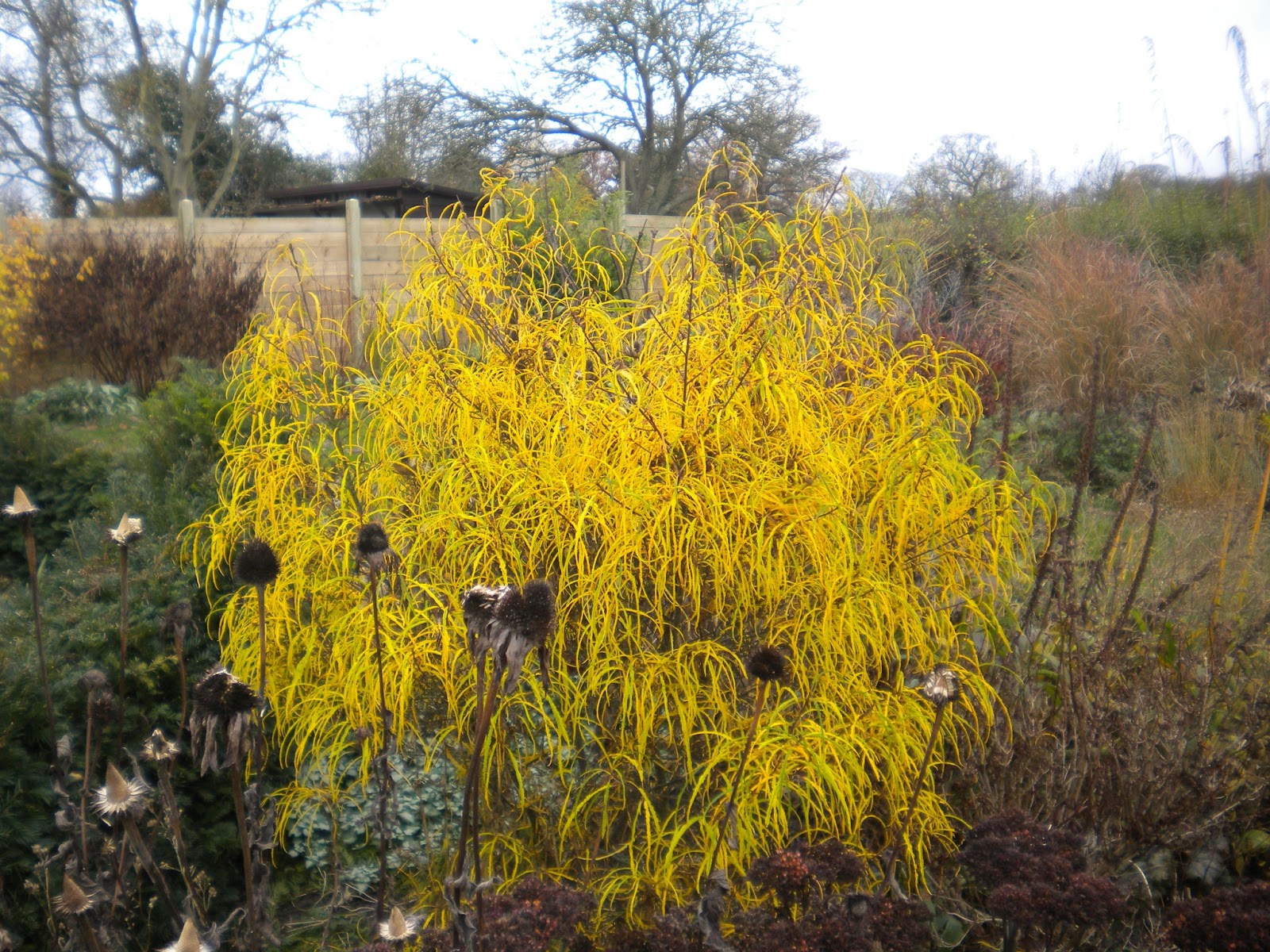
A compact and slow growing shrub that holds onto its autumn colour for a long time.
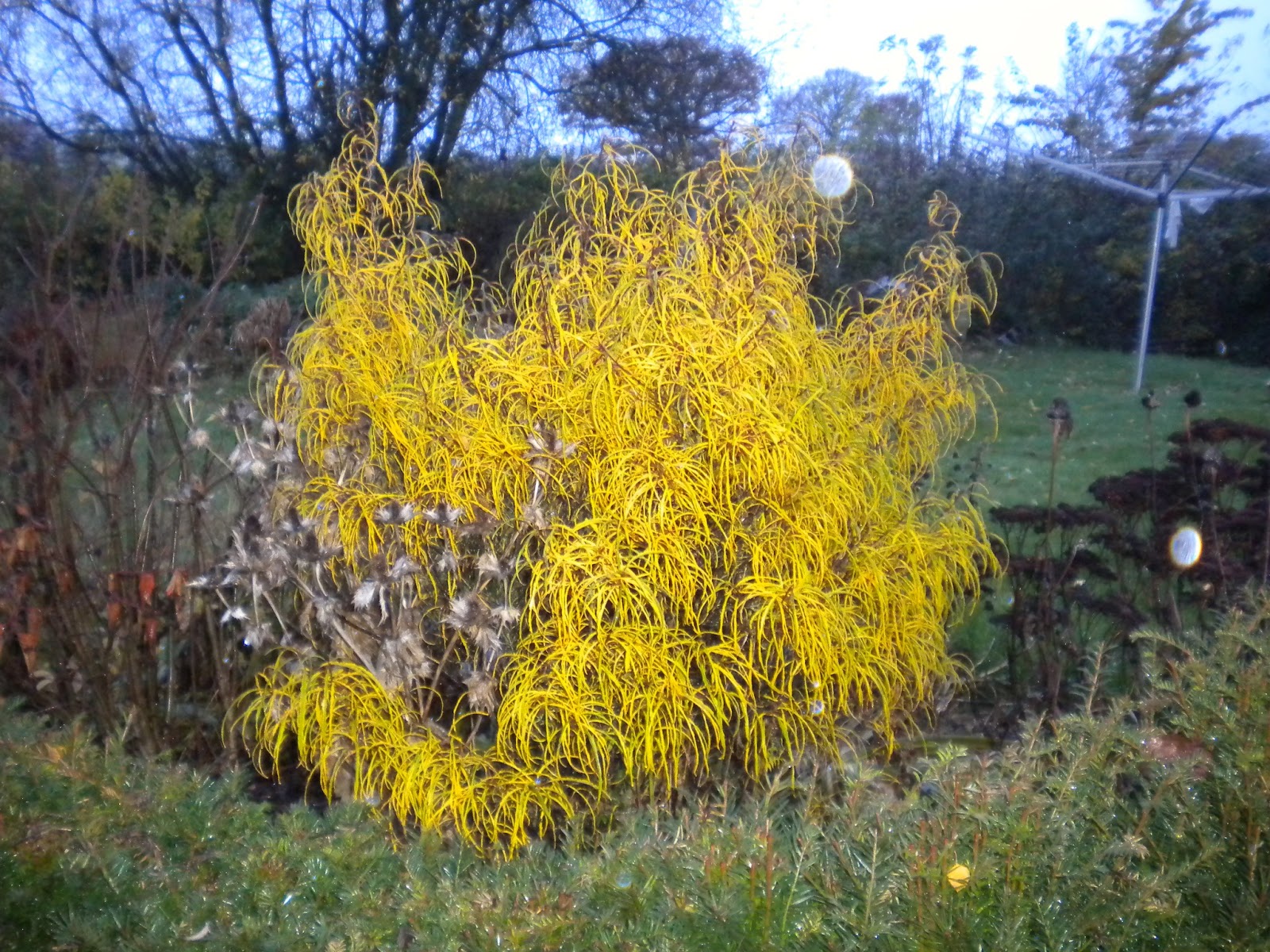
Very narrow leaves hang like firework bursts frozen in time.
...................................
Know your onions.

There are a surprising number of anomalies on plant labels. Send me any you come across via the comments section.
Too twee or not too twee?
Being of a cynical nature I don't usually do twee but I was working in a garden recently and I could not help but feel for this poor little mite. I was tempted to take her home and warm her chilled ceramic heart.


.................................
Pruning
Surprises.
Things you know you know can still take you by surprise.I was pruning a Berberis and an Elaeagnus recently and I know they have lighter undersides to the leaves but was taken aback by quite how white they are on the undersides of the leaves. Having silvery upper surfaces I can understand because it can offer some protection against a scorching sun but a silvery underneath is a bit of a mystery. Any ideas anyone?
Here are a couple of pictures showing the brilliant undersides.

Top……

…….and bottom. Dazzling!

An evergreen Berberis ,( sorry I don’t which one but it is
not a rare one,) with an upturned pruned branch laid against it. In real life it was more startling than this picture
makes it.
...........................
What gets worshipped where? - Synagogue, Welligogue, Guzgogue.
‘…….people who bought this also bought War and Peace by
Tolstoy, T.S.Eliot, Collected Poems, Crime and Punishment by Dostoevsky and a subscription to Playboy
magazine.’ What?
‘…… there were a lot of children off school today; they said it was something to do with
an insect day….. ‘Horses for courses. Main Course - Burger with chips.
A.BC -- WXY.Z ( That’s Zee to make it rhyme.)
It’s curious the things that come to mind when you’re lying
awake up at 3 in the morning. In my mind I was picturing the (I was completely
sober and I have never done drugs in my life) alphabet written out in capitols, sorry, capitals, and
as is the way in dreams I could not
see the whole of each letter just the tops. I noticed that after A they all had flat or roundish tops, BCDEFG, until you came
to H which had two pointy tops
and then there were a series of letters with pointy tops I J K L M N then back to flat tops OPQRST then pointy again UVWXY and a flat
top Z to finish. So, a single
pointy to start and a single flatty to finish. Curious how the shapes of the
tops are all grouped together rather than
mixed up. I did wonder if there was not
some code to the meaning of life hidden in the grouping but that is the sort of thing you think at
3.15 am when you are only half awake.
Still, it is an odd arrangement. Alien intervention? Da Vinci code conspiracy? Quick, under the duvet, here
come the men in white coats.
9V*DC
BACK IN PLAQUE
Is it true that someone has invented a cheap device that you
strap to your wrist and it vibrates your hand to simulate the action of an
electric toothbrush so that you can use your favourite manual toothbrush but get the advantages of an electric
toothbrush? If it is true it won’t be long before you can get a toothbrush app which uses the vibrating facility on your phone and a clip-on toothbrush head to give you the perfect travel toothbrush- you wait and see!


