Wednesday, 13 March 2013

Bourton House Topiary - before and after. Makita memory shtick. Will Gould in Yucatan

This has turned into another bumper  issue. Don't forget new posts are announced on twitter @pwhorticulture and just to let you know that I am leading a Cotswold garden tour this July as part of  Cotswold Walks 2013 programme and it takes in Bourton House which ties in very nicely with  this post's main feature. Be nice to see you there.

Right, here we go..........

I worked  as head gardener at Bourton House for eighteen years. As head gardeners will know get the right team and the job can be the best job ever.  At Bourton we had various gardeners come and go but for a period I had what I have always thought of as my dream team, a golden era! They were two people who had, in different ways, a huge enthusiasm and energy for the garden. There was an eagerness to learn and a genuine excitement when say something new would flower for the first time - they were a real pleasure to work with. They were  Heather Balhatchet nee Price and Will Gould. Will has contributed below to this blog with a piece on his trip to Yucatan.
One criteria for the professional garden photographers who came to the garden regularly was that they had to take a picture of the garden team for our records.The best  picture of them all was the one below taken by Marie O'Hara. I worked with Marie on several occasions and she had imagination, patience, great technical skill and always a great sympathy for the subject.

I am proud to present  my dream team

...

It is all too often the case that designers create a  garden  and then leave it in the 'safe' hands of the client and either  never see it again or see it again a few years later only to find that the no doubt well meaning  meddling of an inexperienced  gardener or the client themselves  has  diluted  their intention to the point where they want to disclaim ownership of the design. It is usually the planting that has been messed with or been badly maintained rather than changes to the basic structure of the garden.

At Bourton I had been in the fortunate position of being able to originate a project from a very elemental start - rooting the cuttings - then nurture it for a number  of years and  then leave it only  to come back many years later to a mature planting that except for minor changes has turned  out exactly as I hoped it would. The project had been to create an architectural feature of box and yew with  an  ironwork centre piece in front of the house.


.   We raised several hundred  box cuttings in cold frames.  Plans were drawn and work began. The topiary garden was developed in front of the house. We dug up the large expanse of gravel covering the space where originally carriages would have  drawn up  to the main entrance. A year or two earlier we had created a much smaller box garden which you can see was left in place to be cannibalised once the larger area of ground was prepared.


 First of all the pattern was marked out with small flower pots to see if it was going to work before  planting began. It all looked so skinny back then. The short sections of box were waiting to grow into a chunkier green version of the terracotta rope edging much loved by the Victorians.The thin wedges were box, the flanking columns - very small here- were yew and the lollipops were Portugal laurel. If I remember correctly the diagonals on the wall were Pyracantha. The picture was taken in spring with the Tulipa kaufmanniana waiting  for some sunshine before they  open their faces to the sky.   


Cuddly serpents.

Is it real?  


We had made a rod for our own backs when it came to clipping time.The  box has been expertly  and lovingly clipped by subsequent garden teams to superb effect.The topiary was established before Box Blight reared its ugly head in 1994 which has been an advantage and  scrupulous attention to hygiene and continual  vigilance has so far kept box blight  at bay. (There is a hint of a pun there)


An earlier 'box' project meant tackling the old rose garden. These images are from old slides and lack a bit of sharpness. Those with a nostalgic hankering  for the slightly fuzzier life of times gone by  might feel  more comfortable with  them.   


Hundreds of cuttings struck in the cold frames were grown on  in the reshaped rose garden. 

  
Early days and still some gaps but it is starting to shape up .
The impressive lattice basket  is cast Victorian concrete  and was  made for the Great  Exhibition of  1851

Getting there, and the old Indian swastika pattern  is becoming obvious. If you visit the garden  and you  are a keen observer you will notice all the swastikas swirl in one direction  except one. I did  not notice the mistake I had made when setting out the pattern until several years after planting. 

Whoa! Greens are good for you! 


Hair cut Sir?
......................................................
Yucatan.

 I would like to introduce you to Will Gould   It is hard to know where to start when describing Will and perhaps a simple list is the easiest way. He is gardener, poet, artist, teacher, enthuser, traveller, motorbiker and all round good guy.       Follow him on twitter  @green_ gould  


   ''Paul asked me if I'd like to post on his blog and since I've recently travelled  to Mexico to escape the January blues, I thought I'd pass on a few notes:
            I flew to the Yucatan, the home of the Mayan civilisation. The peninsula is the tail of Mexico's eastward curl into the Gulf. Bordering jungly Guatemala and Belize to the south, the soil is drier and the air less humid. Temperatures rarely drop below 20 degrees C and peak from 28 in winter to 35 in summer. The wet season from May to October is also the hottest. When I was there in January trees were losing their leaves in preparation for the dry months.  

            It sounds like good growing country but what prevents bountiful tropical jungle is the fact that the whole peninsula is a flat sheet of porous limestone with virtually no surface water. Only the larger forest trees can reach down to the groundwater which can be seen at Cenotes, where weaknesses in the limestone have eroded sufficiently to collapse, revealing bottomless pools of freshwater.''


Tradescantia spathacea  and Ficus dipping their toes:
           

The result of the climate is low scrubby forest that flourishes in the wet then lies dormant and mostly leafless through the dry months.
 Like much of the culture in Latin America, the flora today is one of importation, selection and  survival. Above the fading greens of January, bright yellow interloper Cochlospermum religiosum  (Silk Cotton Tree) pops out  Fremontedendron-like butter cups on bare 'winter' branches.


Along colonial town streets, African tulip tree Spathodea campanulata's waxy orange flowers drop daily on to pavements. Caesalpinia pulcherrima  and 10 ft Brugmansias light up dusty front yards along with Orchids and Bromeliads in typically nonchalant displays. In the corners of car parks, native cotton (Gossypium) and mimosa grows alongside escaped Ricinus. Roadside verges - usually the hotbeds of aliens were largely a tangle of native Ipomoea purples, yellow Bidens and pure red Stachytarpeta, false vervain or snakeweed:


 Just as the present culture and flora is a rich composite, the variety of present day Mexican food is largely the result of imports such as rice, wheat, pigs, chickens and cattle. These are combined with complex spices which were developed to enhance a bland staple diet.
            Traditionally the Mayans grew maize and beans through the wet season, planting crops at the spring equinox and harvesting at the autumn one. Practicing slash and burn methods, they would clear forest , grow for 2 years then leave for 8 to return fertility before the next cycle.  The cycle of rains and maize was so important to them that they held the belief that the gods first made the corn and then fashioned humans from cornmeal. Carvings at ceremonial sites show decapitated warriors sprouting corn from their necks, ironically it is thought that it was the winners of a ceremonial ball game who were given this privilege.
You could say growing maize was in their blood:


Helianthus microcephalus at the roadside:


Recently cleared forest and last years Maize:


The Mayans built pyramids whose height was determined by the forest canopy. At dawn on the equinoxes, those at the top needed to be able to see the approaching sun 'walking' towards them from the horizon. By building their own  mountains, the structures became the highest points on the entire peninsula.

Many thanks Will.
...........................................................................

Crown Gall


Here's an ugly looking piece of stuff. Dave Feaver, a lecturer at Pershore College  brought it in to show the RHS group at our Saturday class. It is Crown Gall  on a  plant of Photinia. Galls can be caused by a range of organisms including fungi, eelworms and insects but this one is caused by bacteria. Crown gall  does not necessarily kill the plant but can certainly weaken it. The bacteria does not penetrate the  root cells but inhabits the space between the cells  and causes them to proliferate rapidly. It can affect both herbaceous and woody plants. There is not any practical control  particularly as it is only usually noticed when  the plant  starts to suffer and is dug up.  Club Root, which also causes swelling and distortion  of  roots  is a gall disorder of members of the Cabbage (Brassica) family and  is caused by a slime fungus. It can be controlled top some extent by raising the pH of the soil. Infected soil should not be used for Brassica  crops for seven or eight years  at least. 
All galls are not as ugly as this, take a look at more appealing  galls in 'Britain's Plant Galls' by Michael Chinery ( Wild Guides Ltd. ) and a lovely old book ' The Pocket Encyclopaedia of Plant Galls' by Arnold Darlington (Blandford)  my edition is dated 1968  and it is long out of print  but there are some available on
..........................................................................


Makita memory shtick

 I am not in the thrall of  Makita and no money has exchanged hands ( Yet. Makita?) but I could not resist posting this picture of the memory stick I was given after a presentation of their landscape and grounds maintenance equipment. (you have to pull off the front of the miniature planer to get to the bit you push into your pc.) It's slightly soft and rubbery and its so cute.

..........................................................

Scary-fication


I have figured out why  lawn scarification is so called - it is because  when you have  scarified the grass  the resulting look is an absolutely 'scary' mess. Here Barney is carrying out the sterling work on a very dreary day. 


.....................................


Giraffe sticks


I turned back a pile of  garden rubbish to start a fire to find these sticks underneath  that had had their bark  gnawed by either mice or voles or shrews. I am sure there is someone out there that  is an expert on UK gnaw marks who can tell me which critter it was. 


Bits and Bobs.


There has been a series on   BBC TV  here in the UK   called 'The  Story of Music' by Howard Goodall which for me was an immense success. And while not wanting to trivialise it in any way at all one of the  things that sticks in my memory is the bit about Lurpak butter.  If you know the product you will know it has a silver wrapper with  the name Lurpak on it, of course, and above the name is what I have always thought of as a  rather quaint bit of  embellishing artwork. However it turns out that the curly bit of the logo with  a bossed plate on the end is in fact a representation of an early musical wind instrument the Lur.  Hence Lurpak. It is a Viking instrument played in Norway since a very long time ago.
 I hear shouts of 'little things please little minds'  and so they do but I don't care one tiny bit.

................................................

I have ruined two laptop keyboards  drooling over the site Paradis Express. It is a heavenly expression of all things beautiful in the garden. It is run by Delphine who gardens thirty or so kilometres north of Paris. Plunge into this site and you will never want to come out.

Another entertaining blog is that of the tatooed gardener. Lots of good info, good humour and if you are of a heavy metal bent lots of good music.
Another blog I read is that of Helen O'Donnell who gardens in Vermont USA. Helen has some great  pictures on her site and it is a very good read. She also seems to  have visited more gardens in the UK than I have.
.......................................


In the  last issue we  had all manner of characters  getting together to create a rural idyll  and I suggested  Sandy Shaw should gather a few people about her to create a seaside scene. Here are a few of her recruits so far.

Michael Fish
Cliff Richard
The Lighthouse family
George Segal
Brian Ferry
David Harbour
Captain Haddock
Beach Boys
Desmond  Deckchair and the Aces
Piers  Brosnan
Jane Shrimpton
Jackson Pollock
Cod Almighty
............................................

It's that  time of year when you start looking out  for frog  spawn and I  found  this  in  the murky depths of my .............

...................mug of  chicken noodle soup!


Sunday, 17 February 2013

Lichen or lichen? Face of Jesus.Wildlife folklore, Earth Star,


Rather than tag it on the end I want to start with Any Other Business. I am  gradually getting to grips with the technology of blogging but I have noticed that depending on which browser you use e.g. Internet Explorer, Chrome, Safari and the like, you might get a different presentation of the blog site. Some fonts don't translate from one  service to another, for example  my  AC/DC  font was okay on I.E. but failed on Chrome. Also on  the mobile version the background image scrolls with the text making it impossible to  read parts of it. Oh what woe! At the moment I have no idea how to overcome these problems but I am working on them. 
     To  post a comment use the button that says 'Post a comment' at the very bottom of the last page of each blog. Don't use the Comments button at  the top right of the page. That is to subscribe to a comments feed and is unduly complicated unless you are desperate to do it. I haven't figured how to remove it yet. 
     The pictures are all mine unless otherwise shown and copyright applies so please ask if you want to use any of them.  

My new postings  are  announced on twitter  @pwhorticulture 

.....................................

Lichen or Lichen?

Fred Astaire and Ginger Rogers sang, - 'You  like  tomayto I like tomarta, you like potayto and I like  potarta, tomayto, tomarta, potayto, patarta , oh lets call the whole thing off...........'  I sang, -  'You say Heushera , I say Heuchera, you  say Weigelia ,I say Weigela, I say Clemaytis  you  say  CLEMatis, you  call it lichen and I call it liken, let's call the whole thing off. ' We'll leave the Heuchera , Weigela, and Clematis thing for another day and just deal with the lichen or liken issue. I looked it up in the dictionary to check out the phonetic  pronunciation and  it says,  '' Pronounced lie-ken ( it was  written out in those  funny phonetic symbols  but they don't come out well in this font  and who actually understands them?)  but  sometimes said  lichen as  in kitchen.''  So there you have it, you can please yourself. Hooray. Well not quite. Lichen comes from Greek and I am not a Greek scholar but I think they would say a hard ch ( Kick)  rather than a soft ch ( Chin).
.
Whatever you call them they are quite a piece of  something. I say something because they are not plants nor are they animals but a combination of two separate organisms, a fungus and either an algae or sometimes  a  cyanobacteria. Cyanobacteria are blue-green bacteria which can make energy from sunlight just like the algae.The fungus and its symbiotic  partner get by  mostly  by the algae or bacteria providing energy  garnered from the sun  and the fungus helps by retaining water and providing a bigger area for capturing nutrients. The relationship is  complex and that explanation is a big over simplification.
This symbiosis allows them to occupy environmental niches that they could not survive in as separate entities. The algae can live without the fungus but the fungus cannot live without the algae. It has always puzzled me how such a mutually reliant existence allows them to reproduce when you have  two different organisms involved but operating as one. It turns out that they  can spread by vegetative means which means bits come off and establish themselves in a new location but they also produce a type of spore which contains a bit of both the algae and the fungus and this is dispersed by the wind. Where there is a need evolution invariably finds a way.
Lichens can withstand considerable desiccation which allows them to colonise  a wide range of often inhospitable environments. The pictures below show them on wood, asbestos, and painted metal which are not particularly   inhospitable  but certainly varied and providing very little nutrition.  .
     This is not meant to be a scientific look at lichens because there are many and varied variations  on the lichen theme  and their life history can be complex. I am more  concerned by the beauty of their shape and colour. Take a look at the British Lichen Society  website for comprehensive information.  

Lichens of many shapes and textures were clinging to an apple tree I pruned recently

The pictures below are all taken within a yard or two of each other and  I would not be surprised if most times when you are outdoors  that along with that rat we are always only a few feet away from you are not that far from a lichen. They are sensitive to air pollution so town dwellers might  have to look a bit harder. 


I live in Potter's Lane and this sign is typical of many where the sign cleaner  never gets - thankfully.  


It would be  perfect if the name of this lichen began with S........


.....and this one began with P.
The  spattered, tiny, coral-like fragments on this P were finely detailed and sublime. 


I borrowed this T from the sign opposite because the lichens were  better than  on the T above.

Lichen on stone wall 1


Lichen on stone wall 2


      Lichen on stone wall 3


Lichens on wooden bench 1


Lichens on wooden bench 2 


Lichen on asbestos shed. 1 (Can you spot the face of Jesus?)


Lichen on asbestos shed 2 or is it a picture of the cosmos or is it just a boring picture? You decide.

I sometime get asked to look at 'diseased' shrubs to advise on what can be done only to  find that the plant in question is just covered in lichens. It is usually on old shrubs where the lichen has had time  to get well established. The lichen does not penetrate the plants and does no harm. This also applies to ivy on trees. The ivy takes nothing from the tree but does make branches heavier and  more likely to break off in high winds or when laden with snow.

Lichen on this small, round leaved deciduous Lilac, Syringa meyeri var spontanea 'Palibin'  gives it a frosted look.

...............................................................................

Earth Star

Here's a curious little fellow.  It is an earth star fungus and more specifically the Arched Earth Star and more scientifically Geastrum fornicatum. Ge = earth as in geology, astrum = star as in Per ardua ad astra and fornicatum  as in, well, what are you expecting?  It means arched or vaulted.  Wikipedia  tells us  about fornication - 'It is a common belief that the origin of the word derives from Latin. The word fornix means "an archway" or "vault" and it became a common euphemism for a brothel as prostitutes could be solicited in the vaults beneath Rome. More directly, fornicatio means "done in the archway," perhaps a reference to prostitution.' Well, well, well, the things you learn from a lowly fungus.  


.............................................................

Wildlife folklore 

I recently asked a friend,Phill Clayton, if he fancied  contributing  to this blog. He did and here it is below.
Phill is an accomplished wildlife photographer and very knowledgeable naturalist. He has logged several species of wildlife never before recorded in South Warwickshire and built up a comprehensive picture library of the wildlife of the local area through birds, flowers and insects. He is a keen conservationist and one of the main movers in the Stour Valley Wildlife Action Group . Much of his work can be seen on their website. (
The group also has a Facebook page.) It is a valuable resource for those interested in the well being of their countryside. 
Take it away Phill. 

''After reading the various posts I thought, having an interest in the natural world, I would like to add a slant in that direction!
A slant perhaps at a tangent  that delves  more  into folklore and myth. Why? Because we have learned much about the natural world over the centuries culminating in some fantastic video footage of species' life cycles that are even stranger than fiction. However, this interest lies in how our ancestors tried to make sense of the living things around them, within the constraints of their times! Probably the most familiar of our wildlife, are the birds we see around our gardens and local countryside!
We can attempt to see these through the eyes of the ancients who wrote about them with, in some cases, great detail.
When Christ was crucified it is said that the Crossbill drew out the nails to release Christ and this is how it has a deformed bill, The red markings are  the blood of Christ from their efforts to free him. Swallows it was believed, flew off with the nails so they couldn't be  used again! It was the Sparrow that followed them and brought them back and for punishment had their legs fixed together invisibly so now they can only hop and never run again. Thus, it was a sin to kill the swallow and some believed that if a farmer does this  his cows will yield blood instead of milk!
(Religion was of course one of the great constraints of these times!)
    Nisus, the King of Megara, had a daughter called Scylla who for the love of Minos betrayed her father and country. On realising her betrayal she  threw herself into the sea in despair and was changed into a lark. This doomed her to be pursued forever by her father who changed into a hawk……….The species name for the sparrow hawk is Accipiter nisus!
    The Cuckoo or Gowk, has been the subject of much folklore. Where did it go in winter, where did it nest, why did it change its song, why did it eat other birds eggs? Why did grasshoppers hatch from its spittle?
The attempts to answer all of these conundrums were quite varied, some believed that cuckoos turned into hawks in the winter (The barred breast of the cuckoo is quite Sparrow hawk-like!). Others believed it hibernated in this country, either in the mud at the bottom of ponds, or would lose its feathers and hide in the hollows in trees and looked like an owl. (Tawny owls nest early in hollows so finding young owlets could explain this!) It was also thought that the cuckoo arrived here on the backs of Kites as their flight was poor! (This probably came about as a coincidence in arrival time!) Some believed a Cuckoo could not sing until it had eaten the egg of a small bird. (Cuckoos do take birds eggs, this is to make room in the nest of the host parents for its own egg, so a thread of truth!) The tiny soft bodied Frog-hopper larvae that secrete the protective foamy substance we know as Cuckoo spit are most evident in the months the Cuckoo sings so again it seems the two must be associated by pure coincidence!
But why did these stories come about?
Explaining why a bird like the cuckoo, (which would have been very common back then!) made itself so obviously present within the few months of summer and then apparently disappearing completely, must have been quite important. For a better or wise person having to explain to a lesser being  that you didn't know the answer would never do! So explanations were created.
I guess by now us commoners should be used to the tales we  have been  spun by our peers ever since!''           

Phill. 
......................................................................

Face of Jesus. 

We've all seen it haven't we?  Pull a slice of toast out of the toaster  and there it is the face of Jesus, spill milk on the table and there it is again; just about to take a sip and there it is, the face of Jesus, in the froth of our pint of Guinness. Well, I was knocking apart an old pallet the other day and there it was, the face of Jesus, but what I hadn't realised was that he smoked. 

..............................

Winter wonders.


This is one of the few variegated plants I get excited by. I grow it alongside the path to the house to cheer me as I go by. It is reliable and  bright and clean  throughout the year but seems particularly so  in the winter  when it shines out against dark wet earth and bedraggled  plant debris. It even looks good through the snow. Yucca filamentosa 'Golden Sword', try it. 


Here are two rather poor pictures of  a plant I have overlooked  for much of my gardening life. Leucojum vernum  This  plant  has been  flowering  from  mid to late January through February in the UK Midlands.  Snowdrops fit in well with winter, they look cold with their pure white flowers and blue tinted foliage but this plant has the luxuriance of a summer flowering  bulb.The foliage is dense and a rich dark green  and the white flowers, held well above the leaves, are perked up with bright yellow anthers and petals with yellowy green tips. It is called the Spring Snowflake but it is too early and far too warm to be called either Spring or Snowflake  Don't miss out on it like I have all these years, track one down in readiness for next winter.    


Flowering it's head off in early February Cornus mas must rate only just behind Hammamelis, Witch Hazel, but ahead  of most everything else for  winter colour. It is a deciduous, hardy, large shrub/small tree that tolerates a wide range of conditions and if you are desperate enough you can make jelly from its berries though it needs a warm spot  to fruit regularly.


.................


It is that time of the year when everyone writes about Hellebores. Here's my contribution. This is a fabulously dark selection from Ashwoods Nurseries Not only are the flowers so very dark but the new foliage is a rich chocolate purple. It is exquisite.  

 There is a lesson to be learned in this  picture.  Because we had a great heap of  them I used felled tree chippings as a mulch. It certainly works well as a weed suppressant and helps retain soil moisture in this free draining sandy soil but it can be distracting when you want to appreciate  some of the smaller plants growing through it. Once the plants are up and  their own foliage acts as a background to their flowers it is fine but in early spring  when the likes of snowdrops, hellebores, species tulips and Cyclamen coum are doing their best to be seen they can be lost against the jumble of  shapes  and colours of the mulch. It will take several seasons before  the mulch  breaks down sufficiently for its colour to darken. 
Another lesson is that when you cut back your old hellebore leaves in winter try not to leave stubby bits of stem showing;it spoils the effect.( I am in a quandary, should that be effect or affect? Help me out English scholars.)  


.............................

Bits and Bobs

Young engineers overheard at Job Centre.... 'Drilling is boring'....... 'I went for a job as a lathe operator. I got turned down.'

...........

In the UK there are several genera of Woodlice, those small ancient looking insects that creep around in damp and shady places. One of the genera is Armadillidium which is a great name to pronounce, but, better still, they are classified in the section  Armadillidiidae - is that an insect or a traditional Irish fiddle tune?

.........


President Carter, Gracie Fields, Bill Gates, Tiger Woods, Charlotte Church, Jenny Meadows, Tim Shepherd, Helen Brook, Billy Twelvetrees, Joan Rivers, Stonewall Jackson, John Farmer, Jim Dale and Giant Haystacks all stand shoulder to shoulder to create a rural idyll. 

Anyone else we should include?

Sandy Shaw could start a seaside scene.

THE END

Sunday, 20 January 2013

Bumper issue. Majorelle, Hoar Frost,Tulips and Barrows - push or pull?

Having been away for so long  I thought I better get out a  bumper issue to make up for lost posts.  Here it is.

 I’ve bin on me ‘olidays. Can you guess where? Here’s a clue which you will have to be of a certain age and of a certain musical bent for it to be any use to you.

 Looking at the world through the sunset in your eyes
Travelling the train through clear xxxxxxxx  skies
Ducks and pigs and chickens call
Animal carpet wall to wall
American ladies five-foot tall in blue.

Sweeping cobwebs from the edges of my mind
Had to get away to see what we could find
Hope the days that lie ahead
Bring us back to where they've led
Listen not to what's been said to you
Goddit?

Well, it was Marrakesh, (Marrakesh in the song Marrakesh Express by Crosby Stills and Nash 1969 but Marrakech in the country today.), the third largest city in Morocco and Wikipedia has just told me it attracts two million tourists a year.

One of the highlights of the holiday was the Majorelle garden in the north of the city. It was the most organised, clean, and unbroken down places we came across.

It was garden created by artist Jacques Majorelle on a plot of 1.6 hectares which he bought in 1923. He called the property Bou Saf Saf and his house  and workshop Villa Bou Saf Saf . By buying adjacent land he gradually expanded the garden to  4 hectares. He opened it to the public in 1947 to help offset the considerable costs of maintenance. Majorelle went through a divorce was remarried and suffered a serious car accident and then another and had to a leg amputated. Due to financial difficulties he had to give up his involvement  in the workshop, house and garden in 1961 and had to return to France where he died in 1962.

Yves Saint  Laurent and his partner Pierre Berge visited the garden in 1966 on a visit to Marrakech  and were taken by the  colours and shapes  of the  plants and garden  if not by the condition it was then in. On learning that it was to be sold and a hotel built on the land they decided to buy the property and did so in 1980. He renamed the house Villa Oasis and lived there working on the restoration of the garden. Irrigation was installed to provide for the individual requirements of the different species of plant. The number of species was increased from 135 in 1999 to some 300 today. Twenty gardeners now take care of the plants, garden ornaments and water  features and the    seventy five people in total are employed to run the property.

Yves Saint Laurent died in Paris in 2008 but his ashes are scattered in the garden in Marrakech.

If you get chance to  visit the garden (Get in there  either early or late in the day  to avoid the visitors  that arrive  in considerable numbers  on  coaches.)  and be sure to  pay the extra  for  a ticket into the Berber museum which was opened in December 2011  in what was the artists’ workshop. It is beautifully designed and the  Berber artefacts , clothing , jewellery are  wonderfully displayed and   comprehensively explained. The garden and museum are now run by the Fondation Majorelle and profits are used to support other projects in Morocco. 


Here are some holiday snaps.
Jacques Majorelle’s and later Yves Saint Laurent’s house.

If you like the blue colour check out Auro paint suppliers. It is one of their concentrated colours which are intended to be diluted with whites and pastels to  paler colours  but used neat gives this intense  colour. 

The garden is neatly raked and the soil dished around the plants to aid watering. Alongside all the exotic succulents it surprised me to see Acanthus mollis. It is in the foreground here. It is a robust,  semi- evergreen, shade tolerant, herbaceous  perennial  that grows well in the UK and  it turns out it has more right to be in the garden than all the other plants because it is native to North West Africa.

Cacti and succulents make up a large part of the planting and give drama to the garden through their shape and size.


As sometimes happens when you are on holiday and  feeling relaxed away from the    responsibilities  and constraints of everyday life, I had a holiday romance. There was no physical intimacy unfortunately because the sudden love of my life was kept ten yards inside the railings.  No, I had not fallen for a hippo at the local zoo. The object of my head over heels love was the gorgeous thing above.  The Bismarck Palm – such  an unfortunate name for one so lovely.

She  is a plant  from the highlands of central Madagascar. She is adorable. Coming from uplands with cooler winters she is able to tolerate  lower temperatures than might be expected, down as far  as freezing in fact  though not much below that. So if you have a  sheltered spot give her a try though be aware that if she likes you and does manage to grow happily she can make twenty five   metres high and each leaf can make three metres across - oh how heavenly that would be.    


Oh, how could you resist such a plant!
Bismarckia nobilis - pah! Let’s rename it with something more  elegant . How about Palmia gloriosa or Exaltat formosus, even  Madagascaria  gloriosa?   No? Okay.  I wonder what the Madagascans  call it in Malagasy, surely something beautiful?


The  structures  are simple  and the shapes and colours very strong giving many of the views  the quality of a child’s painting.


It’s drama all the way.


The garden has the feel of a botanic garden in places with plants arranged as isolated specimens rather than as a part of a co-ordinated  ornamental design.     


Interest ranges from squat barrel cacti at ground level to towering palms heading to the skies.


 Bamboos flank the far paths. This is not the best of pictures because there is no reference of scale  but the new green shoot in the foreground is about two and a half metres tall and as thick as your forearm. The Swiss Cheese plants in the background give some idea of how big the bamboo shoots are.
...................................

What’s the marra with ya barra?
Any physicists  out  there? No need for  a particle or astro kind just a good old fashioned practical type who understands gradients, friction and can cope with factoring in a few variables.

My  challenge , which  is  a problem  that  has me in a quandary  whenever I work in  a  particular garden  of which a good part is on a  slope   and  the  compost bin is right at the top of the  garden up a steep and sometimes muddy slope, is this. Which is the most efficient way to get a barrow to the top of the hill? Is it pushing the barrow up before you or pulling it up behind you? My basic  understanding of physics tells me that the same amount of energy must be used  whichever way  you  do it, everything else being equal,   because   in both cases  you  are   moving the load  a  certain distance  and raising it a  certain  height in roughly the same time.   However it is the variables that are the spanners in the works and while they   do not affect the weight or distance moved they do affect the comfort, safety and endurance of the barrow pusher/puller.
Let’s consider the two different techniques.  First pushing the barrow. Here I always feel that I am pushing the barrow more into the ground than  along the  line of travel, particularly if the slope  is steep and the load heavy because you have to lift  the handles to give you weight  to help give  your feet some grip on the ground. If you don’t lift the handles  then you have to lean well forward which means the  weight is on your toes  and you have less contact ( and therefore  less grip)  with the ground and the danger then is that your feet will  slip and  shoot out behind you  and any slips at this stage means there is a chance the barrow will run back onto you. Of course all this depends on how slippery the surface is and also  what sort of  footwear you have  on; a good pair of well cleated boots will give you more security and confidence to shove than a pair of smooth soles more suited to a soft shoe shuffle. So as as you see Mr Physicist, it is not all as straightforward as you might think.

The other way is to pull the barrow up the hill but that brings its own problems. Here again the  task is made more difficult on slippery ground because you have to lean forward to  be able to pull  properly and then there is the risk of  your feet slipping   under the barrow and  skinning the back of  your heels This can also happen if the barrow is of poor design  and the handles  are too short. One advantage with pulling is that it is easier to keep the flat of your foot on the ground which gives you more grip. Something else that can catch you out is if the grips on the handles are loose and suddenly slip off when you are pulling your hardest and you go flying and so does the barrow. 

I can feel your yawns from here and hear you wondering why on earth is he telling us all this; who cares? I guess you are right, who cares? Perhaps rather than a serious consideration of the physics of the Barrow Dilemma this could well be a more worrying symptom of what happens when you work too long on your own. I love gardening, there is no doubt about that, but much of it is really quite boring  so when you are working  away on your own, particularly if the task is tedious and arduous, your mind tends to  latch on to distractions. These minor entertainments often set off a train of thought that runs on a course of its own and is sometimes unstoppable at least until the buffers of a more interesting job are hit. That is how the barrow thoughts started off. The job of lugging barrow loads of garden waste to the top of a slippery hill  made more demanding by fatigue and aching  joints desperately needed a distraction. Working out the advantages and disadvantages of each   style made it into an experiment which kept me so preoccupied  with the physics that, hey, before I knew  it the sun was setting and it was time to knock off.
P.S. Whichever way you choose, push or pull, make sure your tyres are blown up hard.

................................ 

Hoar Frost.
As ever nature provides tons of free entertainment in the garden. A recent hoar frost brought a welcome bit of sparkle to a cold and overcast day. Here are some pictures of some of the intimate treats laid on by nature. (Hoar frost has nothing do with getting the cold shoulder down at your local brothel).


Viburnum flowers - brave souls.


Spider’s web and four very handsome fingers..

Cherry Laurel leaves trimmed with icy spikes.


There are advantages to not cutting your plants back too soon.  This is an Agapanthus head strung with tinsel-like frost and surprisingly green for December.


It’s curious how the frost only develops on one side of the branches in certain parts of the garden.
Caused by a very gentle breeze perhaps?


A very ordinary elderberry seedling becomes rather special. What is it doing still bearing  its leaves in December?


Good old Jack F.


 .......................................

Tulip Bulbs.
Can I draw your attention to this quarter’s issue of Hortus  and more particularly the cover? For me it illustrates the  great pleasure to be had from noticing the ordinary which when noticed transcends the ordinary which then becomes the very special.  It is a simple but beautifully executed ink and water colour picture by Simon Dorell   It shows  twelve bulbs  set out  in a regular pattern and the thrill of thrills for me is  that  they are my favourite bulbs and I am excited that someone else has been moved by their shape and texture and in this case moved  enough and with the skill enough to paint them. I am talking about the bulbs themselves here not the flower. The bulb is Tulipa batalinii ‘Bronze Charm’. The flower of this tulip is small and utterly charming but the pleasure starts way before the flower shows itself. It starts at planting time.Take a bulb in your hand  and you will see that it is much smaller than your usual bedding tulip; each bulb is loosely wrapped in  a papery, not fragile but usually split, skin of the warmest, softest  brown with a matt almost downy surface. At the base of each bulb where last year’s roots have withered away is a knobbly pig’s nose. At the other, top, end is a small, tight tuft of soft bristles. The whole is a masterpiece of tactile, textural and visual delight that it almost seems a sacrilege to bury it in the ground.

The lightly textured and matt finish of the paper that Hortus is printed on makes the perfect foundation for this picture. Do your best to get hold of a copy. (The Hortus website image does not do the picture any sort of justice)

P.S. Seen with Magoo vision the picture  can also look like twelve  snails on a ceremonial march- past but don’t let that  put you off.

 Not Tulipa ‘Bronze Charm’ but the very similar ‘Bright Gem’. It is a poor picture but none the less captures the heart melting charm of these oft over-looked but very easily grown small tulips.

 ..............................

 Ivor Field speaks to the nation.
As gardeners we are always encouraged to get as much organic matter into the soil as possible to improve its structure and water holding capacity.  I was wondering how farmers  keep their soil in good condition and was also wondering about potato crops  some of which I know of, not far from here, are still in the ground and  bearing in mind the amount of rain we have  suffered  how are farmers coping, so I asked Ivor for his views.  

‘’Hi Paul, Yes very wet still but the January outlook at least shows signs of drier weather – Locally only about 30% of winter wheat planted and lots of crops looking v.thin (slug damage and rotting of seed due to waterlogging). The potato situation is pretty dire- most of those crops will be lost now. Biggest problem is also those that have been lifted and in store – many will rot in storage due to poor conditions at lifting last autumn. You will notice many more blemishes on the tubers this year.  Let’s hope for a better spring but when you have nearly 40 inches of rain from mid-April onwards, the Organic Matter levels have limited impact – You are right, the more OM the better the soil can cope but once the land saturated and the water table as high as it is then the only thing is patience! OM are increasing with many more combinable crops returning the straw to the land rather than baling – particularly with the break crops of Rape and Beans – the cereal straw in our part of the world still of great feed value/bedding for the livestock farms, particularly further west(Wales) where arable crops are sparse. The burning ban has helped Organic Matter status but made grass weed control much more difficult. You will notice a lot more fields with black heaps of sludge in them over the last 3 years or so – this is human sewage sludge from the Sewage Treatment Plants from nearby and is being used to raise fertility and improve Organic Matter/soil structure. Only limited amounts can be applied every few years to avoid a build-up of heavy metals (cadmium etc. which are harmful to health) and helps solve the Water Companies problem of what to do with all the waste!! Controlling Tomato and Caraway plants that appear in the crops in late spring following the spreading of the human waste is also interesting – such are the challenges facing an agronomist, farmers and a nation of curry lovers! Happy New Year, Ivor.’’

.................................. 


The Girls head South.


I have received a letter from my old pals Grace an’ Perry. (Yes, she is the genuine champagne Perry but Grace is just Grace.). They have moved from their home in the Lake District and are now living right deep in the South West and learning Japanese. What on earth are you girls doing down there?  Is there another major garden project underway? Let’s hope so. Or are you chasing men?  What’s with the Japanese lingo, I can’t believe there’s a Japanese diaspora near St Ives. I don’t want to hear you are developing a Japanese garden; leave it to the Japanese. Is it that painterly light that lured you so far down south? It would surely suit your style. Anyway, that photo of a plant you sent me, ( Poor picture by the way.)I can’t believe you don’t know what it is. Is it growing at your new property? Was the picture taken recently because it often flowers through the winter in a sheltered spot though a cold snap will slow it up a bit? It grows in a tangled sort of way up to about a metre high and is evergreen.  It is quite a  gem. Its soft lemon yellow pea flowers complement perfectly the grey tinged leaves. The  variety  ‘Citrina’  is a pale flowered selection of the less exciting  bright yellow  flowered  Coronilla valentina subsp. glauca which is a blue grey leaved subspecies of the green leaved and more  brazen yellow flowered Coronilla valentina, complicated eh? But not to worry you have the choicest variety of them all there. Take a sniff. You will find the flowers carry a light, fresh scent. Cut a small posy for the house if your plant is large enough to stand the loss, and enjoy its scent indoors

Be sure to let me know  what you are up to – we have readers who want to know!


......................... 

Autumn Colour.
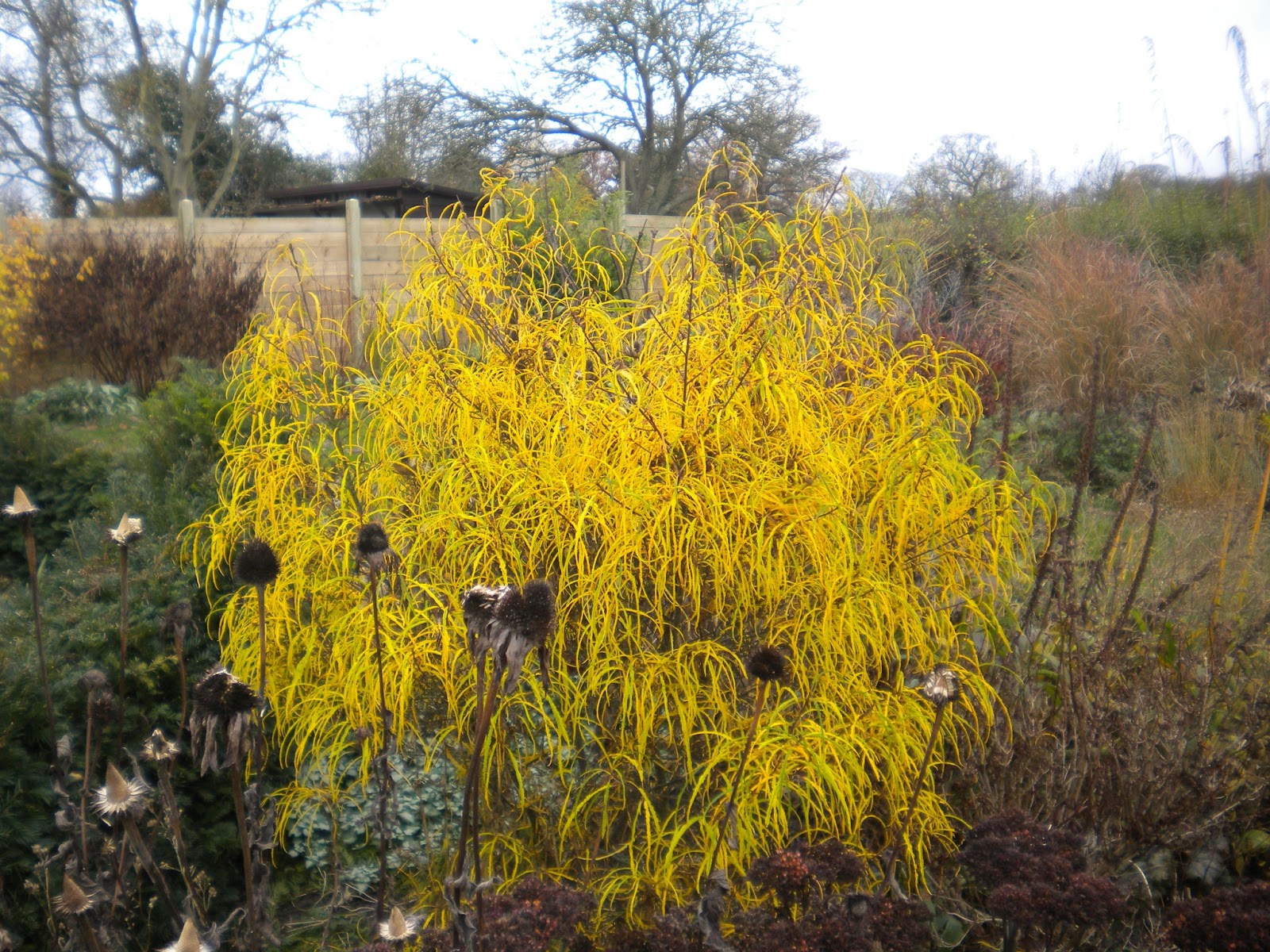
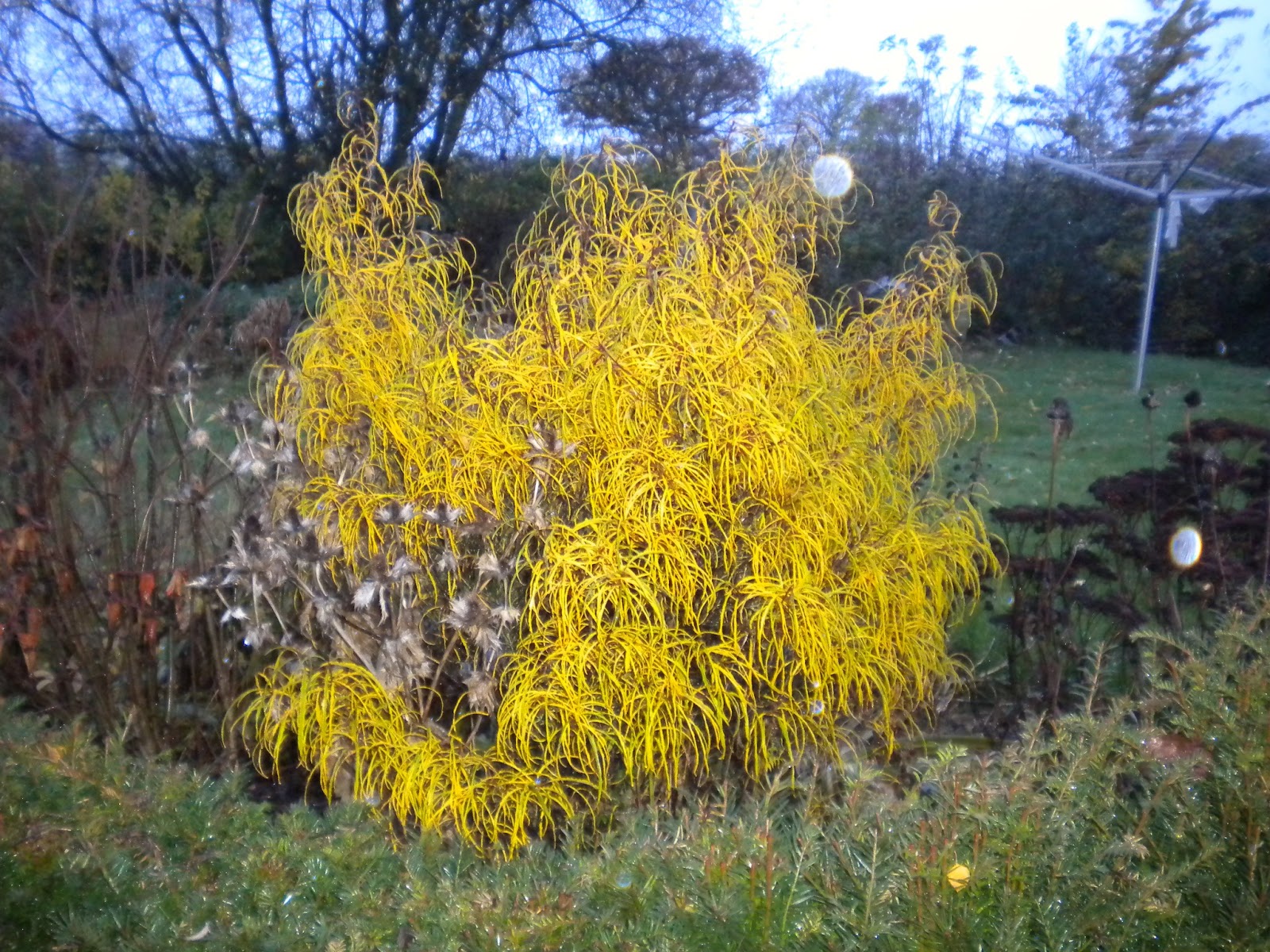
Here is a picture of a slow growing shrub in my garden. It has been there four years and has not yet been pruned. It went in at  about two feet high  and though I don’t know exactly how big it is now  you can see by the heads of the Echinacea  and Eryngium in the foreground it is still not very big,  a yard  and a half max. Snag is I can’t remember what it is. I think it is a Rhamnus but can’t be sure. It gives  you a fuzzy ,soft effect during the summer with its narrow foliage and then in the autumn explodes into this starburst of fierce yellow. Great value and minimal maintenance – BUT WHAT  IS IT?   M’AIDEZ!

Half an hour later  ………. It’s funny how things come to mind when you stop thinking about them. Rhamnus frangula ‘Asplenifolia’

A compact and slow growing shrub that holds onto its autumn colour for a long time.


Very narrow leaves hang like firework bursts frozen in time.

...................................

Know your onions.
Take a look at the label from a pack of Senshu WINTER onion sets for planting in August to September to grow through the WINTER. Read the line just above the diagrams.


There are a surprising number of anomalies on plant labels. Send me any you come across via the comments section.


Too twee or not too twee?

Being of a cynical nature I don't usually do twee but I was working in a garden recently and I could not help but feel for this poor little mite. I was tempted to take her home and warm her chilled ceramic heart. 


.................................

Pruning Surprises.
Things you know you know can still take you by surprise.

I was pruning a Berberis and an Elaeagnus recently and I know they have lighter undersides to the leaves but was taken aback by quite how white they are on the undersides of the leaves. Having silvery upper surfaces I can understand because it can offer some protection against  a scorching sun but a silvery underneath is a bit of a mystery. Any ideas anyone?                                                                                                                                                                         

Here are a couple of pictures showing the  brilliant undersides.

Top……

                                                           …….and bottom. Dazzling!


An evergreen Berberis ,( sorry I don’t which one but it is not a rare one,) with an upturned pruned branch laid against it. In real life it was more startling than this picture makes it.

...........................

 Seen and Heard, Odds and Sods.

What gets worshipped where? -  Synagogue, Welligogue, Guzgogue.

‘…….people who bought this also bought War and Peace by Tolstoy, T.S.Eliot, Collected Poems, Crime and Punishment by  Dostoevsky and a subscription to Playboy magazine.’     What?
‘…… there were a lot of  children off school  today; they said it was something to do with an insect day….. ‘

Horses for courses.    Main Course - Burger with chips. 
‘Mixed Race’………..  Sack, three  legged,  and egg and spoon  100 yards medley.


A.BC -- WXY.Z ( That’s Zee to make it rhyme.)
It’s curious the things that come to mind when you’re lying awake up at 3 in the morning. In my mind I was picturing the (I was completely sober and I have never done drugs in my life) alphabet  written out in capitols, sorry, capitals, and as is the way in dreams I could not see  the whole of each letter just the tops.  I noticed that after A they all had flat or roundish  tops, BCDEFG,  until you came  to H which had two pointy tops  and then there were a series of letters with pointy  tops I J K L M N then back to  flat tops OPQRST then pointy again UVWXY  and a flat  top Z to finish.  So, a single pointy to start and a single flatty to finish. Curious how the shapes of the tops   are all grouped together rather than mixed up. I did wonder if there was not some code to the meaning of  life  hidden in the grouping  but that is the sort of thing you think at 3.15 am when you are only half awake.  Still, it is an odd arrangement.  Alien intervention?  Da Vinci code conspiracy? Quick, under the duvet, here come the men in white coats.
9V*DC
 BACK IN PLAQUE  
Is it true that someone has invented a cheap device that you strap to your wrist and it vibrates your hand to simulate the action of an electric toothbrush so that you can use your favourite  manual toothbrush  but get the advantages of an electric toothbrush? 

If it is true it won’t be long before you can get a  toothbrush app which uses the vibrating   facility  on your  phone  and a clip-on  toothbrush head  to give you the perfect travel toothbrush- you wait and see!